Grammarly for your terminal.
The red squiggly line from your editor — now for the prompts you type into Claude Code, Codex, Aider, and any other terminal app.





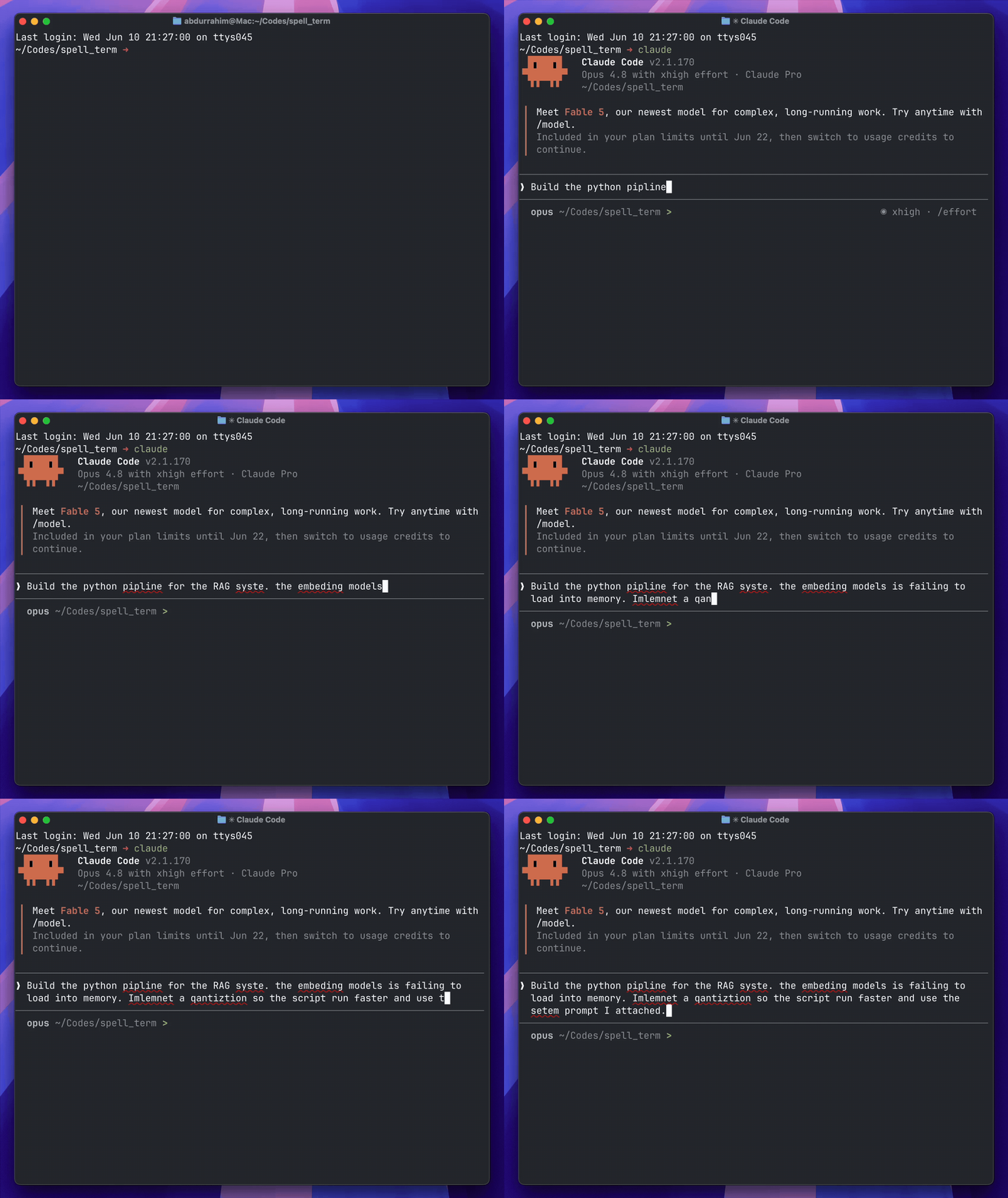
tuipo catching typos in a prompt to Claude Code. It never touches the app it's wrapping — the underlines are drawn on top.
I type a lot of prose into terminal apps — long prompts for Claude Code, Codex and other AI agents, commit messages, SQL, quick notes. None of them spell-check, so my typos just sail straight through into prompts and history. My editor has had the red squiggly line for years; my terminal never got it.
So I built it. You wrap a terminal program once, and you get that squiggly line
back — in Claude Code, Aider, Codex, vim, psql, your shell, whatever. It only
shows up when you actually misspell something, and it never changes how the app
you're running behaves.
To be fair: modern LLMs shrug off everyday typos — mistype "recieve" and Claude knows what you meant. But that robustness comes from the model having seen a word (and its common misspellings) countless times, so it fades exactly where the stakes are highest: rare words, names, and jargon, where the model quietly guesses — and an agent doesn't ask, it acts on its guess. It shrinks with model size, too: what a frontier model shrugs off, the local Qwen or Gemma behind your coding agent has to guess at. Spelling also outlives the prompt: agents echo your words into commit messages, PR text, comments, and docs. And plenty of what you type in a terminal is read by humans in the first place — commit messages, SQL, notes — where a typo just stays a typo.
A few things I cared about while building it:
- It stays invisible until you need it. Nothing pops up while you type; the underline appears in the small pause after you stop, which is when your eyes are actually scanning back over the line.
- It never gets in the app's way. tuipo sits between your keystrokes and the program and draws on top of the screen — it never rewrites what the app prints. The wrapped app behaves exactly as if you'd run it directly.
- It only nags about real words. Code-shaped tokens (
snake_case,--flags,paths/like/this,CamelCase, backtick spans, numbers) are skipped, so it underlines your sentences, not your identifiers. - It's quiet by default. Out of the box you get spelling underlines and nothing
else. Grammar hints, the suggestion picker, Tab-to-fix — all off until you turn
them on from
config.
# Homebrew (macOS & Linux)
brew install ARahim3/tuipo/tuipo

# or with cargo
cargo install tuipo

# or the shell installer (URL is in each release's notes)
curl --proto '=https' --tlsv1.2 -LsSf \
  https://github.com/ARahim3/tuipo/releases/latest/download/tuipo-installer.sh | sh
From source
git clone https://github.com/ARahim3/tuipo
cd tuipo
cargo build --release
# binary at ./target/release/tuipoInstall a shell hook once, and every new terminal session is wrapped automatically — you never have to think about it again:
tuipo init            # adds the hook to ~/.zshrc or ~/.bashrc
tuipo init --dry-run  # just print the line it would add, don't write anything
Open a new terminal and you're covered everywhere. (The hook guards against re-entry, so it won't wrap itself.)
If you'd rather not have it always-on and only want it inside a specific app — say, just Claude Code — skip the hook and wrap that command directly:
tuipo -- claude
tuipo -- aider
tuipo -- psql mydb
tuipo -- bash
Anything after -- is the command tuipo wraps, run exactly as you normally would.
tuipo is intentionally minimal by default. Turn on more when you want it:
tuipo config           # interactive settings editor
tuipo config --print   # print current settings as TOML
tuipo config --path    # show where the config file lives
Settings live in ~/.config/tuipo/config.toml (all keys optional):
| Key | Default | What it does |
|---|---|---|
paint |
true |
The inline underline overlay. Turn off to make tuipo do nothing. |
underline |
"auto" |
Underline style: auto, plain, or fancy (curly red). |
tab_fix |
false |
Tab fixes the most recent misspelling with the top suggestion. |
picker |
false |
Pick among suggestions inline (hover tooltip + Tab). |
grammar |
false |
A small, careful set of grammar hints on top of spelling (below). |
status_row |
false |
A little issue-count line at the bottom. |
pause_ms |
150 |
How long you have to pause before underlines show up. |
hover_ms |
250 |
Idle time before the picker tooltip appears. |
dict_path |
— | Path to your own word list (one word per line). |
Got project names or jargon that keep getting flagged? Drop them in
~/.config/tuipo/dict.txt, one per line.
Every setting also has an env-var override for one-off sessions (env wins over the
file) — e.g. TUIPO_PAINT_OFF=1, TUIPO_TAB_FIX=1, TUIPO_GRAMMAR=1. Run
tuipo --help for the full list.
Spelling is the default; grammar is opt-in and kept deliberately small. Terminal
prompts aren't essays — they're full of imperatives, lowercase starts, fragments,
and no end punctuation, so broad grammar checking misfires constantly. With
grammar = true, tuipo surfaces only a narrow, high-confidence slice (subject–verb
agreement, malapropisms, eggcorns, common usage slips) and leaves the noisy stuff
off. It's tuned for how people actually type in a terminal, not lifted from a
desktop grammar checker.
tuipo opens a pseudo-terminal, runs your command inside it, and passes bytes both ways. On the way in, it reconstructs what you've typed and runs it through the open-source Harper checker. On the way out, it watches the screen the app draws so it can place each underline exactly under the flagged word — using only relative cursor moves, so it never messes with scrollback or the app's layout. When you pause, it paints. If you ask it to fix something, it "types" the correction into the app's input (backspaces + the replacement), so the app reacts as if you'd typed it yourself. The app is never modified and never sees anything unusual.
Does it slow down or interfere with the app I'm wrapping? No. Passthrough is byte-for-byte and the app behaves exactly as if you launched it directly. Painting only happens during idle pauses, when the app is idle too.
Will it mess with tab-completion or my keybindings? No. Tab passes straight through to the app by default, so shell completion, vim indent, and slash-command menus keep working. Fixing is opt-in, and even then it stays out of the way while you're typing forward.
Which terminals work? macOS and Linux. You get curly red underlines where the terminal supports them, with an automatic fallback to a plain underline where it doesn't (e.g. Apple Terminal).
Does it work with non-English text?
Not yet — Harper, the engine underneath, is English-only today. Words from other
languages in the same alphabet ("ragazzo", "bonjour") will usually get underlined
as unknown, though loanwords English has absorbed ("croissant", "rendezvous") pass
clean. The underline is passive — nothing is blocked or changed — and words you mix
in regularly can go in ~/.config/tuipo/dict.txt so they're never flagged again.
If Harper grows other languages, tuipo inherits them.
How do I turn it off for a bit?
TUIPO_PAINT_OFF=1 tuipo -- <cmd>, or set paint = false.
Nothing here is sticky:
# 1. if you ran `tuipo init`, delete the hook line from your shell rc
#    (~/.zshrc or ~/.bashrc) — it's the single line containing TUIPO_ACTIVE
# 2. remove the binary
brew uninstall tuipo
brew untap ARahim3/tuipo      # optional: drop the tap too
# 3. optional: remove your settings + custom dictionary
rm -rf ~/.config/tuipo
If you skip step 1, no harm done — the hook is guarded ([[ -x … ]]), so once the
binary is gone it simply does nothing. Deleting the line just tidies up the file.
Issues and PRs welcome. cargo build, cargo test, and please keep
cargo clippy --all-targets -- -D warnings clean before opening a PR.
Spell and grammar checking is powered by Harper. Built in Rust with portable-pty, vte, and crossterm.
Dual-licensed under MIT or Apache-2.0, your choice. Unless you say otherwise, anything you contribute is licensed the same way.
tuipo is an independent project and isn't affiliated with, endorsed by, or sponsored by Grammarly, Anthropic (Claude), or anyone else mentioned here. Those names are only used to describe what tuipo works with, or — for "Grammarly for your terminal" — to give a quick feel for what it does. It's not the same engine or feature set. All trademarks belong to their owners.