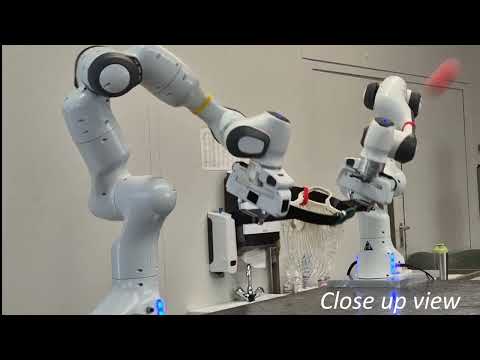
A Cooperative Dual-arm system for dynamic ball catching, coordinated to mimic human upper-body behavior (two arms moving around a shared torso-like reference with shoulder-style synchronization).

This algorithm selects an optimal interception point from a predicted ball trajectory by filtering points within a safety region, classifying them based on proximity to an object, and choosing the point that requires minimal velocity for interception.The Code is in kalman_filter/kalman_filter_bringup/kalman_filter_action_client_3_time_based.py .

Input: Full predicted ball trajectory Output: Filtered set of candidate points S.
- Extract only trajectory points that fall within a predefined safety region S.
- This ensures the selected interception point is reachable and safe for the intercepting object.
For each point in the filtered set S, calculate its distance to the object center cobj and assign it to one of two sets:
Near-Object Set (Sobj)
- Condition: ∣∣pcurr−cobj∣∣≤robj
- Contains points within the object radius robj
- These points are in immediate proximity to the object
Safe-Tracking Set (Ssafe)
- Condition: ∣∣pcurr−cobj∣∣≤rsafe
- Contains points within the safe tracking radius rsafe
- These points are further away but still trackable
Priority Rule: If a point qualifies for both sets, Sobj takes priority.
Evaluation Order
- First evaluate candidates from Sobj(near-object set)
- If no feasible point found, evaluate candidates from Ssafe (safe-tracking set)
Interception Velocity Calculation
For each candidate point, compute the required velocity:
vreq = ∣∣pcurr−cobj∣∣/ (tint − tmin)
Where:
pcurr = current candidate point position
cobj = object center position
tint = estimated interception time for this point
tmin = minimum time constraint

-
End-to-end ROS 2 stack: perception → prediction → planning → control (C++/Python)
-
AI perception & prediction: YOLO detection + Kalman/EKF for real-time ball trajectory estimation
-
Nonlinear MPC planning: CasADi/Ipopt for synchronized dual-arm motion under constraints
-
Real-time control: ros2_control torque-PD loop at 1 kHz; ~30 ms planning cycle
-
Sim-to-Real robustness: Gazebo/MuJoCo simulation parity and reproducible launch configs
-
Safety & limits: joint/velocity/torque limits, timeouts, and recovery behaviors
-
Modular design: reusable ROS 2 nodes, clear interfaces , easy extension to new tasks