


SentinelOps is an autonomous SRE (Site Reliability Engineering) agent built for the MongoDB Atlas Track. It combines Google Cloud's Gemini 2.5 Enterprise Agent Platform with MongoDB Atlas Vector Search to deliver intelligent incident response, semantic document grounding, and persistent memory.
This hackathon submission showcases MongoDB Atlas integration with vector search, real-time data visualization, AI-synthesized agent memory, and semantic grounding across 10+ SRE runbooks — with matched runbooks and cosine-similarity scores surfaced live in the chat UI.
🎯 MongoDB Atlas Track Submission - All core features utilize MongoDB Atlas M0 free tier for vector embeddings, persistent state, and agent memory.
Watch the full demo: https://youtu.be/QrElopiAmoU
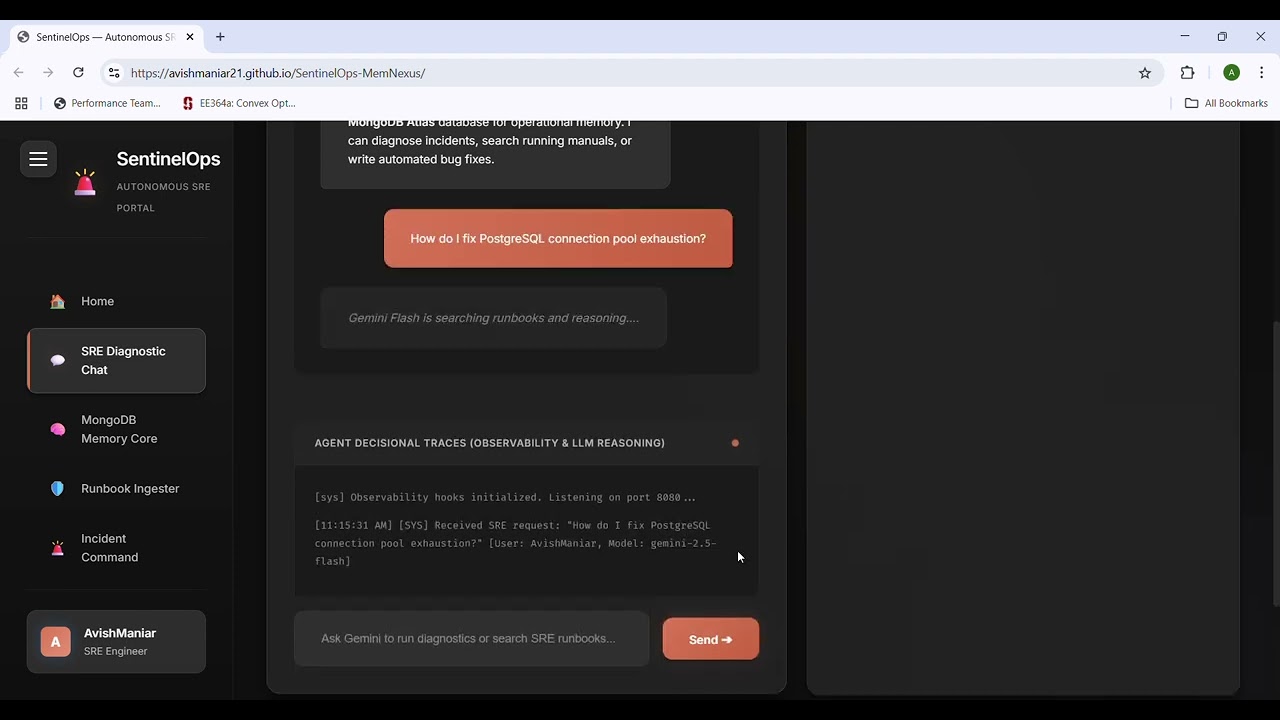
Live App (frontend): https://avishmaniar21.github.io/SentinelOps-MemNexus/ Live API (backend): https://sentinelops-api-782741881130.us-central1.run.app
# 1. Confirm everything is online (backend, Vertex AI, MongoDB, MCP)
curl https://sentinelops-api-782741881130.us-central1.run.app/api/health

# 2. Ask the agent a real SRE question — watch it ground on a runbook via Atlas Vector Search
curl -X POST https://sentinelops-api-782741881130.us-central1.run.app/api/chat \
  -H "Content-Type: application/json" \
  -d '{"message":"How do I fix Nginx rate limiting during a DDoS?","user_id":"demo"}'
The chat response includes a grounding_sources array showing exactly which runbooks MongoDB Atlas Vector Search matched, and how strongly.
Want to test the system? We've prepared sample content for you:
-
SAMPLE_QUESTIONS.md - 50+ ready-to-use questions across Redis, MongoDB, Nginx, Kubernetes, security, and more. Each question triggers vector search and shows grounding sources.
-
SAMPLE_RUNBOOKS.md - 6 production-ready runbooks (PostgreSQL, Elasticsearch, Docker, Kafka, GitLab CI/CD, Terraform) that you can copy-paste into the Runbook Ingester to expand the knowledge base.
Try asking a question from SAMPLE_QUESTIONS.md, then ingest a runbook from SAMPLE_RUNBOOKS.md and see it appear in the grounding sources!
A 4-minute guided tour of the dashboard:
- System Status (top-right badge) — Click it. All four services report live health: Backend, Vertex AI, MongoDB Atlas, and the MongoDB MCP Server. Auto-refreshes every 30s.
- SRE Diagnostic Chat — Ask "How do I fix Redis cache key eviction?" The agent runs MongoDB Atlas Vector Search, then answers grounded on the matched runbook. Below the answer, the 📚 MongoDB Atlas Vector Search Results panel shows the top 3 matched runbooks with % match scores.
- Switch the model — Toggle ⚡ Flash → 🧠 Pro and re-ask. Flash answers in ~7s; Pro takes longer (~20s) but returns more structured, deeply-reasoned output. Same vector grounding on both.
- MongoDB Memory Core — Open this tab to browse the three live Atlas collections:
users(with Gemini-synthesized memory summaries),sessions(chat history), andknowledge_vectors(runbooks with truncated 768-dim embeddings shown). - Webhook (optional) — Fire an authenticated alert at
/api/webhook/alert(see below) to trigger autonomous diagnosis from an external observability tool.
Note: Dynatrace and GitLab panels in the UI are clearly badged SIMULATION / DEMO DATA. The core graded integration is MongoDB Atlas.
Every chat query flows through MongoDB Atlas Vector Search before the model answers:
- The user's message is embedded with Google
text-embedding-004(768 dimensions). - An Atlas
$vectorSearchaggregation finds the closest runbooks by cosine similarity. - The top matches are injected into Gemini's context, so answers are grounded in real SRE runbooks — not hallucinated.
- The matched titles + scores are returned in
grounding_sourcesand rendered in the chat UI.
Real example — query: "How do I fix Nginx rate limiting during a DDoS?"
📚 MongoDB Atlas Vector Search Results
  #1  Nginx Reverse Proxy Rate Limiting & DDoS Prevention   86% match
  #2  Dynatrace Server Latency Spike — CPU 98.4% Recovery   78% match
  #3  MongoDB Connection Fault & Pooling Guide              74% match
🤖 AI-Powered: Dual Gemini models (Flash/Pro) • Vector search across 10+ SRE runbooks (768-dim embeddings) • Persistent chat history • Autonomous diagnostics
📚 Visible Grounding: Matched runbooks and cosine-similarity scores shown live in the chat UI, so you can see why the agent answered the way it did
🔍 Search System: Content search • Command palette • Smart suggestions • Live results with 300ms debounce
🔔 Notifications: Real-time alerts (critical/warning/info) • Dropdown panel with badge counter • Dismissible notifications
🔗 Webhook Integration: /api/webhook/alert endpoint • Built-in tester • Cloud Logging • Optional X-Webhook-Secret authentication
Note: Dynatrace and GitLab features in UI are demonstration simulations (clearly badged). Core integration is MongoDB Atlas (hackathon track).
🧠 MongoDB Atlas Integration (Primary Track Feature)
- Vector Search with 768-dim embeddings (cosine similarity)
- 3 Collections:
users,sessions,knowledge_vectors - AI Memory Synthesis: Gemini automatically generates user summaries from conversation history
- Grounding sources: matched runbooks + relevance scores surfaced in the UI
- Live database explorer in UI
- Batch ingestion API for 10 runbooks
- Atlas M0 free tier with connection pooling
🎨 Modern UI/UX: Glassmorphic dark theme • Fixed sidebar • Responsive layout • Smooth animations • System status monitor with auto-refresh
📊 System Status: Real-time health checks (Backend, Vertex AI, MongoDB, MCP) • 3 states: Online 🟢 / Degraded 🟡 / Offline 🔴 • Interactive badge • 30s auto-refresh
SentinelOps-MemNexus/
├── src/                           # Backend Python code
│   ├── agent.py                  # Flask API with Gemini, MongoDB MCP client
│   └── index_docs.py             # MongoDB document ingestion script
├── scripts/                       # Utility scripts
│   ├── batch_ingest_via_api.py   # Batch SRE runbooks ingestion via API
│   └── ingest_sre_library.py     # Local runbook ingestion script
├── docs/                          # Documentation
│   ├── DEPLOYMENT.md             # Cloud Run deployment guide
│   ├── SECURITY.md               # Security & credential management
│   └── TEST-DEPLOYMENT.md        # Post-deployment testing guide
├── index.html                     # Main dashboard UI (GitHub Pages)
├── app.js                         # Frontend controller with status monitoring
├── styles.css                     # Modern glassmorphic styles
├── config.js                      # Environment detection & API config
├── LICENSE                        # MIT License (hackathon requirement)
├── deploy.ps1                     # Secure Cloud Run deployment script
├── Dockerfile                     # Multi-runtime container (Python + Node.js)
├── requirements.txt               # Python dependencies
├── .env.example                   # Environment variable template
├── .gitignore                     # Git ignore patterns
├── .gcloudignore                  # Cloud Run deployment exclusions
└── README.md                      # This file
Backend (src/agent.py):
- Flask REST API with CORS enabled
- Gemini 2.5 Flash & Pro model integration
- MongoDB Atlas client with connection pooling
- MongoDB MCP Server client (JSON-RPC 2.0)
- Google Cloud Storage for runbook backups
- Google Cloud Logging for audit trails
- 4 Vertex AI tools: search_knowledge_base, load_user_memory, save_chat_history, execute_mongodb_mcp_tool
Frontend (GitHub Pages):
- Vanilla JavaScript (no frameworks)
- Real-time system status monitoring
- Vector-search grounding display in chat
- Advanced search with autocomplete
- Interactive notification system
- Responsive glassmorphic design
Container (Dockerfile):
- Python 3.11 slim base image
- Node.js 20+ for MongoDB MCP server
- Multi-runtime support (Python + Node.js)
- Optimized for Cloud Run deployment
Production Deployment: https://sentinelops-api-782741881130.us-central1.run.app
API Endpoints:
GET /- Basic API status checkGET /api/health- Comprehensive system health monitoringGET /api/db/collections- View all MongoDB collectionsPOST /api/chat- Chat with Gemini agent (model selection + grounding sources)POST /api/diagnose- Autonomous incident diagnosisPOST /api/runbook/ingest- Upload single runbookPOST /api/runbook/ingest-library- Batch upload 10 runbooksPOST /api/webhook/alert- Receive observability alerts
Backend: Python 3.9+ (Flask) • Gemini 2.5 (Flash/Pro) • MongoDB Atlas Vector Search • GCS Backup • Cloud Logging • Docker
Frontend: Vanilla JS • HTML5 & CSS3 (glassmorphic) • Flexbox/Grid • Custom animations
Cloud: Google Cloud Run • Vertex AI • MongoDB Atlas M0 • GitHub Pages
- Google Cloud Account with $100 credits or free trial
- MongoDB Atlas account (free M0 cluster)
- Python 3.9 or higher
- Google Cloud SDK CLI installed
git clone https://github.com/AvishManiar21/SentinelOps-MemNexus.git
cd SentinelOps-MemNexus# Authenticate with Google Cloud
gcloud auth application-default login
# Enable required APIs
gcloud services enable run.googleapis.com
gcloud services enable aiplatform.googleapis.com
gcloud services enable storage-api.googleapis.com
gcloud services enable logging.googleapis.com- Create a free M0 cluster at MongoDB Atlas
- Create database:
memnexus_db - Create a Vector Search Index named
vector_indexon theknowledge_vectorscollection:
{
  "fields": [
    {
      "numDimensions": 768,
      "path": "embedding",
      "similarity": "cosine",
      "type": "vector"
    }
  ]
}- Important: Add
0.0.0.0/0to Network Access (IP Whitelist) to allow Cloud Run connections
# Copy environment template
cp .env.example .env

# Edit .env and add your credentials
# GCP_PROJECT_ID=your-project-id
# MONGODB_URI=mongodb+srv://user:pass@cluster.mongodb.net
# WEBHOOK_SECRET=your-secure-random-secret # protects /api/webhook/alertpip install -r requirements.txt# Start Flask API
python src/agent.py
# In another terminal, serve the frontend
python -m http.server 8000
# Open http://localhost:8000 in your browser# Deploy using the deployment script
.\deploy.ps1 YOUR_MONGODB_PASSWORD
# Or manually:
gcloud run deploy sentinelops-api \
--source . \
--region us-central1 \
--allow-unauthenticated \
--set-env-vars "GCP_PROJECT_ID=your-project,MONGODB_URI=your-connection-string,WEBHOOK_SECRET=your-secret"# After deployment, populate 10 SRE runbooks
python scripts/batch_ingest_via_api.pySentinelOps uses MongoDB Atlas as the foundational data layer for all agent memory, state, and semantic search capabilities. Here's the complete integration:
# Atlas Vector Search Index Configuration (index name: "vector_index")
{
  "fields": [
    {
      "numDimensions": 768,
      "path": "embedding",
      "similarity": "cosine",
      "type": "vector"
    }
  ]
}knowledge_vectors- 10 SRE runbooks with 768-dim embeddings fromtext-embedding-004sessions- All chat conversations with timestamps and user contextusers- User profiles with AI-synthesized memory summaries (Gemini-powered)
# Four production tools integrated with Gemini
1. search_knowledge_base(query: str) → Vector search across runbooks
2. load_user_memory(user_id: str) → Retrieve user context
3. save_chat_history(user_id, message, response) → Persist conversations + AI memory synthesis
4. execute_mongodb_mcp_tool(tool_name, arguments) → Execute MCP server tools- Official MCP Server: Uses
mongodb-mcp-server(pre-installed in the container) - JSON-RPC 2.0 Protocol: Custom Python client for subprocess communication
- Cross-Platform Support: Works on Windows (local dev) and Linux (Cloud Run)
- 25 MCP Tools Available: Database queries, aggregations, schema inspection, index operations
- Gemini Integration: MCP tools accessible to the AI agent as Vertex AI functions
- Health Monitoring: MCP server status tracked in real-time via
/api/health
The dashboard includes a live MongoDB Memory Core tab with:
- User profiles viewer (with Gemini-synthesized summaries)
- Chat history explorer
- Vector runbooks browser
- Real-time collection updates
- Atlas M0 Free Tier - Fully operational
- Network Access - Configured for Cloud Run connectivity
- Connection String - Securely managed via environment variables
- Google Cloud Vertex AI SDK integration
- Gemini 2.5 Flash and Pro model support
- Application Default Credentials authentication
- $100 GCP credits utilized for premium features
- Four production tools integrated with Gemini:
search_knowledge_base()- Vector search functionload_user_memory()- User context retrievalsave_chat_history()- Conversation persistence + AI memory synthesisexecute_mongodb_mcp_tool()- MongoDB MCP server integration
- Function calling with structured outputs
- Dynamic tool registration based on MCP availability
- MongoDB Atlas M0 cluster with Vector Search
- 768-dimension embeddings using text-embedding-004
- Three production collections: users, sessions, knowledge_vectors
- Cosine similarity semantic search with grounding scores in UI
- 10 pre-loaded SRE runbooks with full vectorization
- Real-time synchronization between agent and database
- Connection pooling for production performance
- Official MongoDB MCP Server (
mongodb-mcp-server) - JSON-RPC 2.0 client for MCP communication
- 25 MCP tools for database operations
- Google Cloud Secret Manager integration (optional)
- Secure credential management via environment variables
- MongoDB connection string securely configured
- Cloud Run deployment with managed secrets support
- Multi-runtime Docker container (Python 3.11 + Node.js 20+)
- Deployed to Cloud Run (serverless)
- Gemini safety filters configured
- Webhook authentication (X-Webhook-Secret) to prevent quota abuse
- CORS enabled for cross-origin requests
- Graceful subprocess management with cleanup
- MIT License included in repository root
- Public repository with visible license badge
- Open-source contributions enabled
Dashboard Tabs: Incident Command | SRE Diagnostic Chat | MongoDB Memory Core | Runbook Ingester
Interactive Components: System Status Monitor • Global Search • Notification Bell • Model Selector • Vector-Search Grounding Display • Webhook Tester • Terminal Logs
10 pre-configured incident response guides (vectorized with text-embedding-004): MongoDB Connection Fault • Node.js OOM Heap Leak • Nginx Rate Limiting & DDoS • Kubernetes Disk Exhaustion • Redis Cache Eviction • DNS Resolution Failure • SSL/TLS Certificate Expiry • Database Replication Lag • Dynatrace CPU Recovery • GCP IAM Access Denied
Chat: Ask "How do I fix MongoDB connection timeouts?" → Agent searches runbooks using vector similarity and shows the matched sources + scores
Search: Type "redis cache" → Finds Redis runbook instantly
Webhook: Send observability alerts via /api/webhook/alert (requires X-Webhook-Secret header if WEBHOOK_SECRET env var is set)
curl -X POST https://sentinelops-api-782741881130.us-central1.run.app/api/webhook/alert \
  -H "Content-Type: application/json" \
  -H "X-Webhook-Secret: your-webhook-secret" \
-d '{"alert_name": "CPU Critical", "severity": "CRITICAL", "source": "Dynatrace"}'Key Endpoints:
GET /api/health- System health monitoring (4 services: backend, vertex_ai, mongodb, mcp_server)POST /api/chat- Chat with Gemini agent (params: message, user_id, model; returns response, model_used, grounding_sources, traces)GET /api/db/collections- View all MongoDB collections (users, sessions, knowledge_vectors)POST /api/runbook/ingest-library- Batch upload 10 SRE runbooksPOST /api/webhook/alert- Receive observability alerts (requires X-Webhook-Secret)
Status Values: online | degraded | offline | unknown
| Issue | Solution |
|---|---|
| MongoDB connection offline | Add 0.0.0.0/0 to MongoDB Atlas Network Access |
| Vector search returns nothing | Ensure the index is named vector_index on knowledge_vectors |
| Cloud Run deployment fails | Ensure .gcloudignore excludes temp directories |
| Runbooks not appearing | Run python scripts/batch_ingest_via_api.py |
| Search not working | Hard refresh browser cache (Ctrl+Shift+R) |
- Cloud Storage: Automatic backup of ingested runbooks to GCS
- Cloud Logging: All API requests and webhook alerts logged with severity tracking
- Model Selection: Switch between Gemini 2.5 Flash (fast) and Pro (deep reasoning) mid-conversation
- AI Memory Synthesis: Gemini generates concise per-user memory summaries from chat history
- Notification System: Real-time alerts for critical events, CPU/memory warnings, and backup status
This project was built for the Google Cloud Rapid Agent Hackathon. Contributions welcome! Fork → Feature branch → Pull Request.
MIT License | Avish Maniar (@AvishManiar21)
Built for the Google Cloud Rapid Agent Hackathon - Powered by Gemini 2.5 & MongoDB Atlas