
hal0 turns a Linux box — ideally a Ryzen AI Max+ 395 with 128 GB of unified memory — into a polished, OpenAI-compatible inference appliance. Hardware-aware slots, prewired chat UI, signed self-update. One command installs the lot.
Every inference workload runs as its own podman container under a
hal0-slot@<name>.service unit. hal0-api on :8080 is the sole
control plane — it owns slot state machines, dispatches OpenAI-compatible
/v1/* requests to the right slot port, and serves the dashboard. No
shared inference daemon; no extra process to babysit.
curl -fsSL https://hal0.dev/install.sh | bashStatus: v0.9.0 — first public beta. Container-runtime era, declarative config. Each slot (
agent,utility,embed,rerank,stt,tts,img,vision, NPU trio) runs as a dedicated podman container (hal0-slot@<name>.service). Slot definitions live in/etc/hal0/slots/<name>.toml; backend profiles in/etc/hal0/profiles.toml; the model catalog isregistry.toml— the single source of truth for every HuggingFace coordinate and SHA-256 digest. The launch command for every slot is resolved from a single source (deduped, with per-flag provenance), Stacks apply declarative model/slot layouts atomically, and profiles share the same portable export/import envelope. hal0 is Strix Halo native, not Strix-Halo-only: experimental CUDA + multi-GPU pinning ride alongside the ROCm/Vulkan defaults. Companion services (Open WebUI, ComfyUI, Hermes, Hindsight) are managed from one Services dashboard page with mDNS discovery; the dashboard itself has a redesigned fixed-band layout with a live telemetry header. Seed profiles are virtual (code-defined, self-healing on upgrade) with dedicated embed/rerank lanes and a model×profile×slot MTP decision; models carry a preferred runtime profile, interrupted pulls resume, and voice runs end-to-end (NPU STT + Kokoro or GPU Qwen3-TTS). The one-liner writes the first-run sentinel only — no model picks, no downloads; runhal0 setupanytime to configure models, extensions, and NPU interactively. SeePLAN.md§1 for what ships now and the path to v1.0.
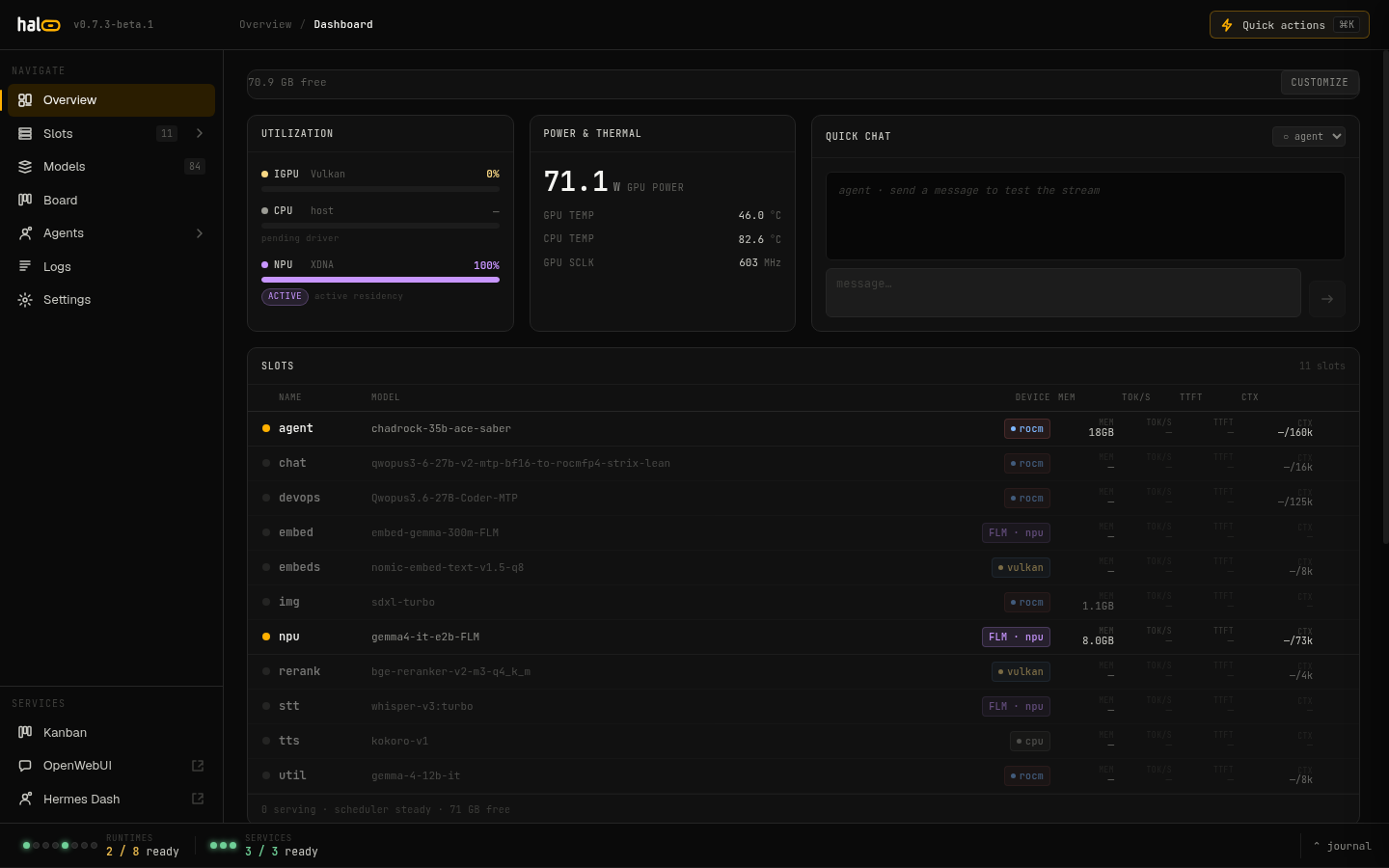 Dashboard — unified-memory hero, at-a-glance health, and live slot rows. |
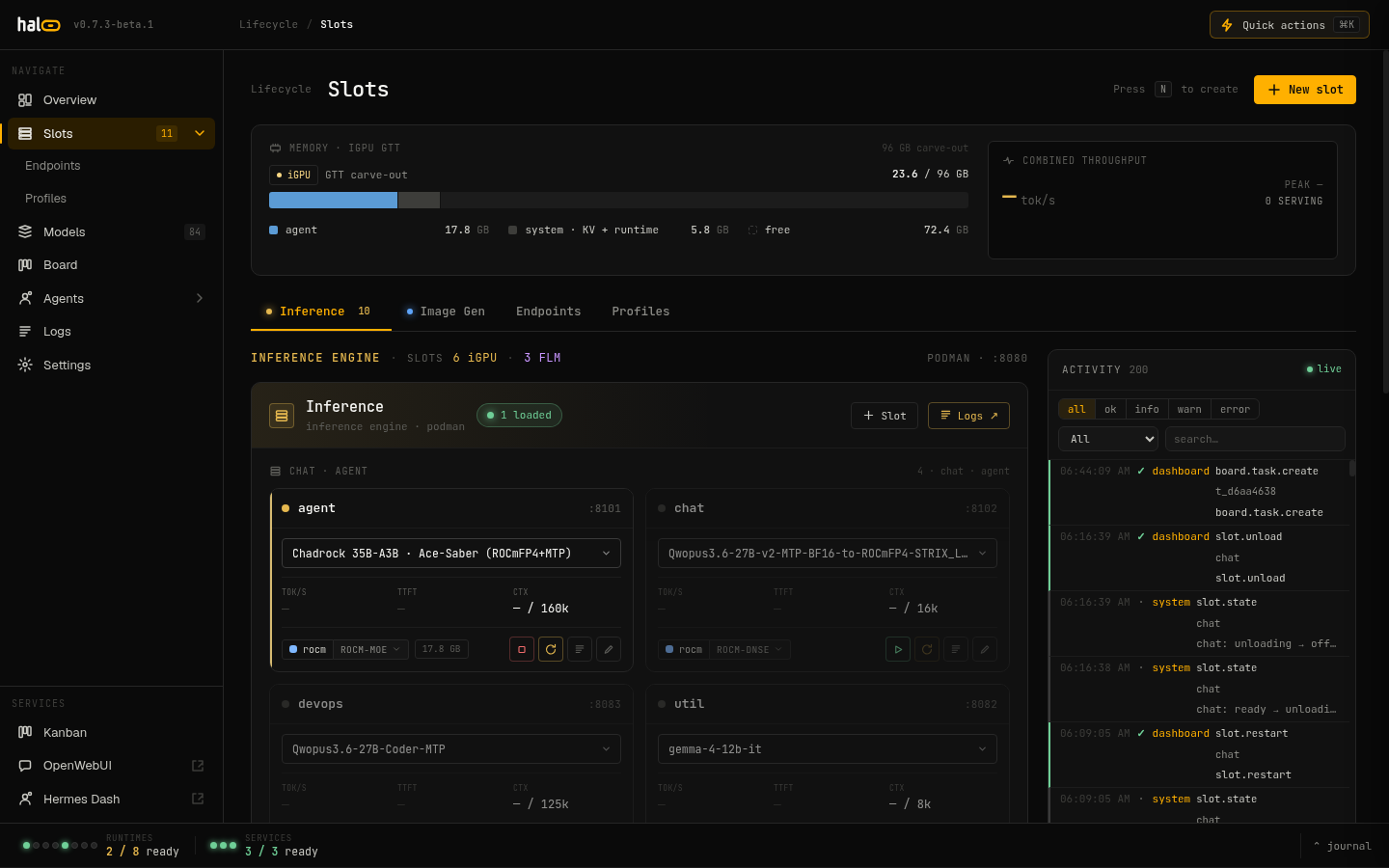 Slots — the inference engine: per-slot models, devices, and live telemetry. |
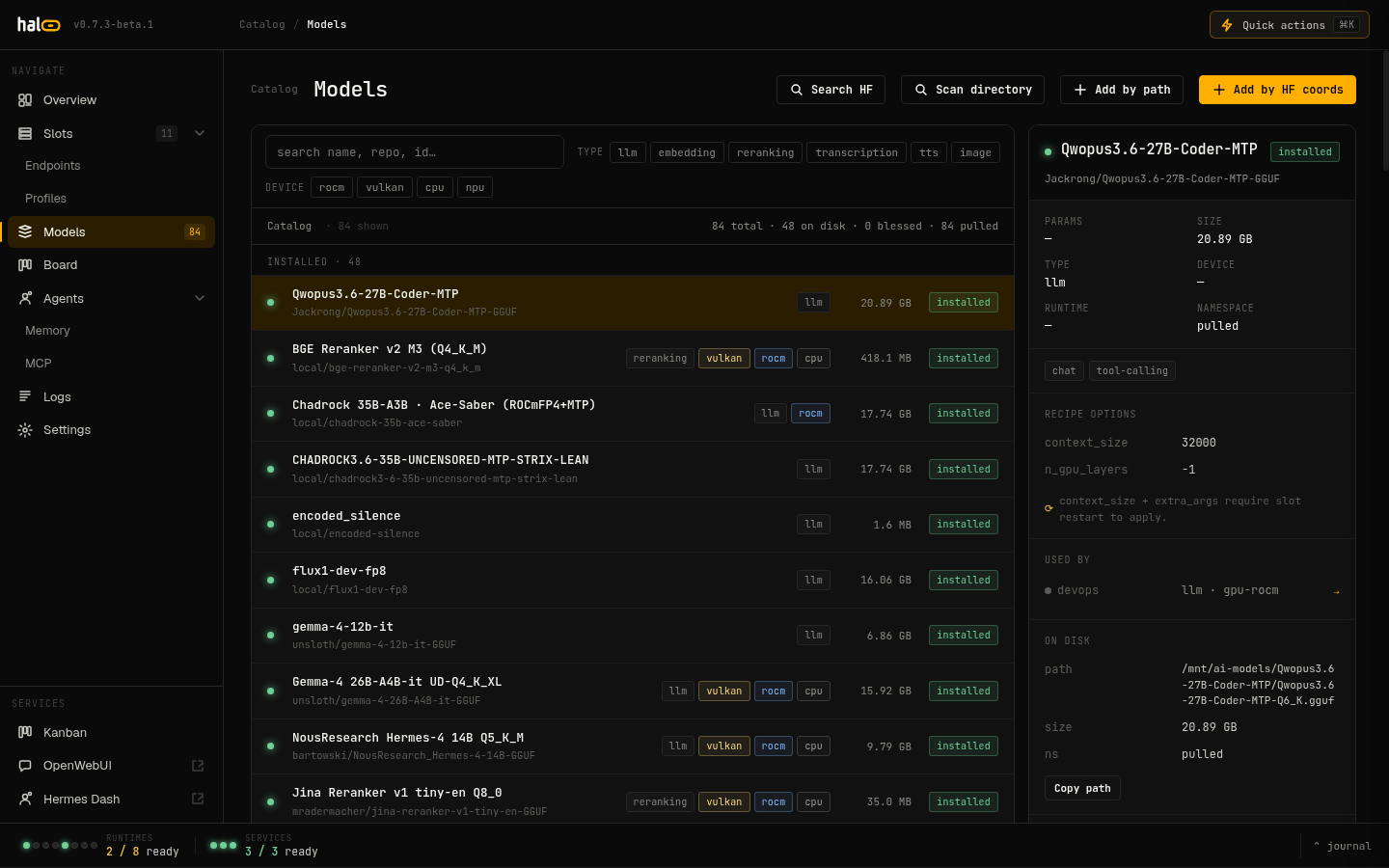 Model registry — catalogue with quant chips and pull status. |
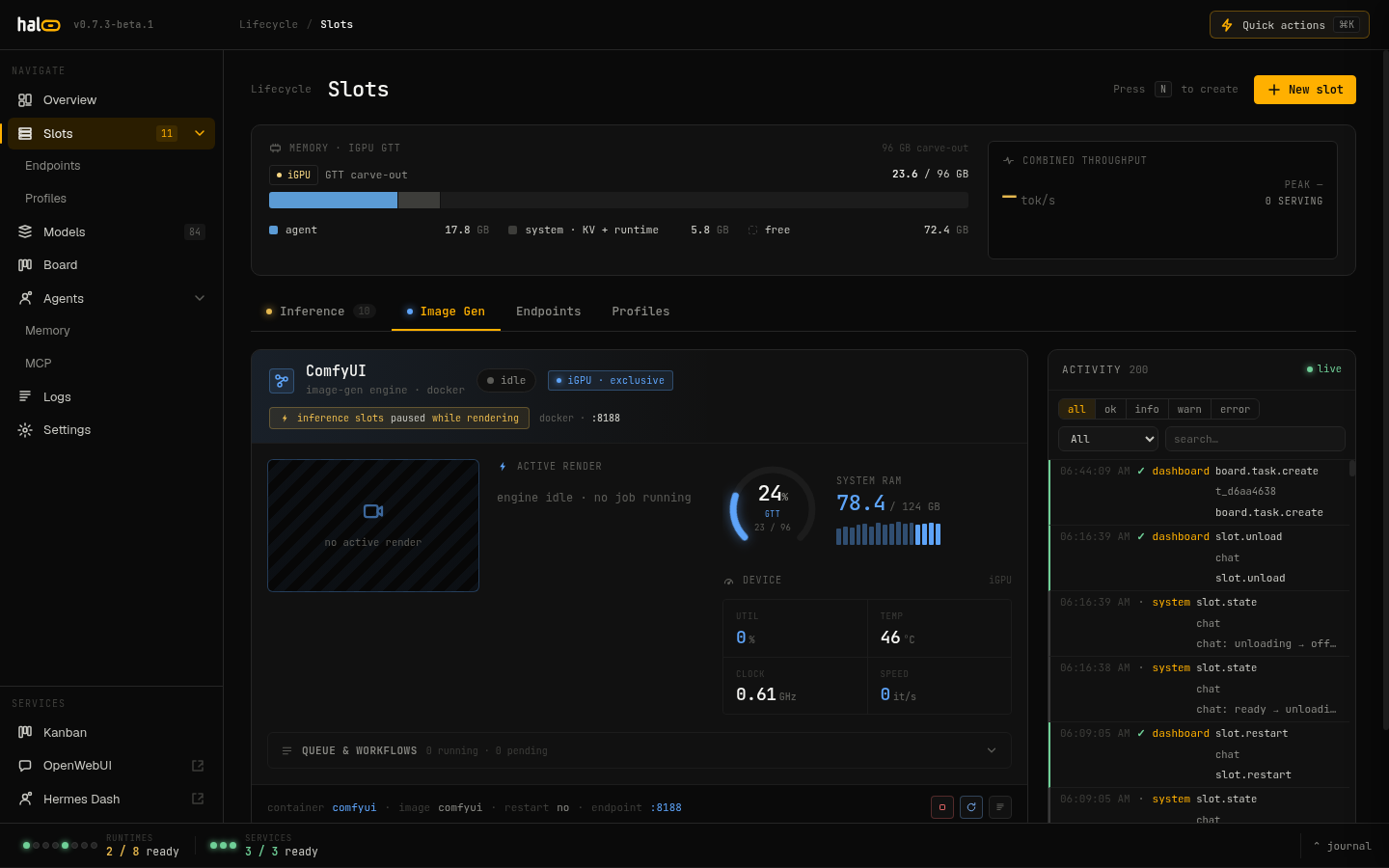 Image generation — ComfyUI queue and GPU gauges. |
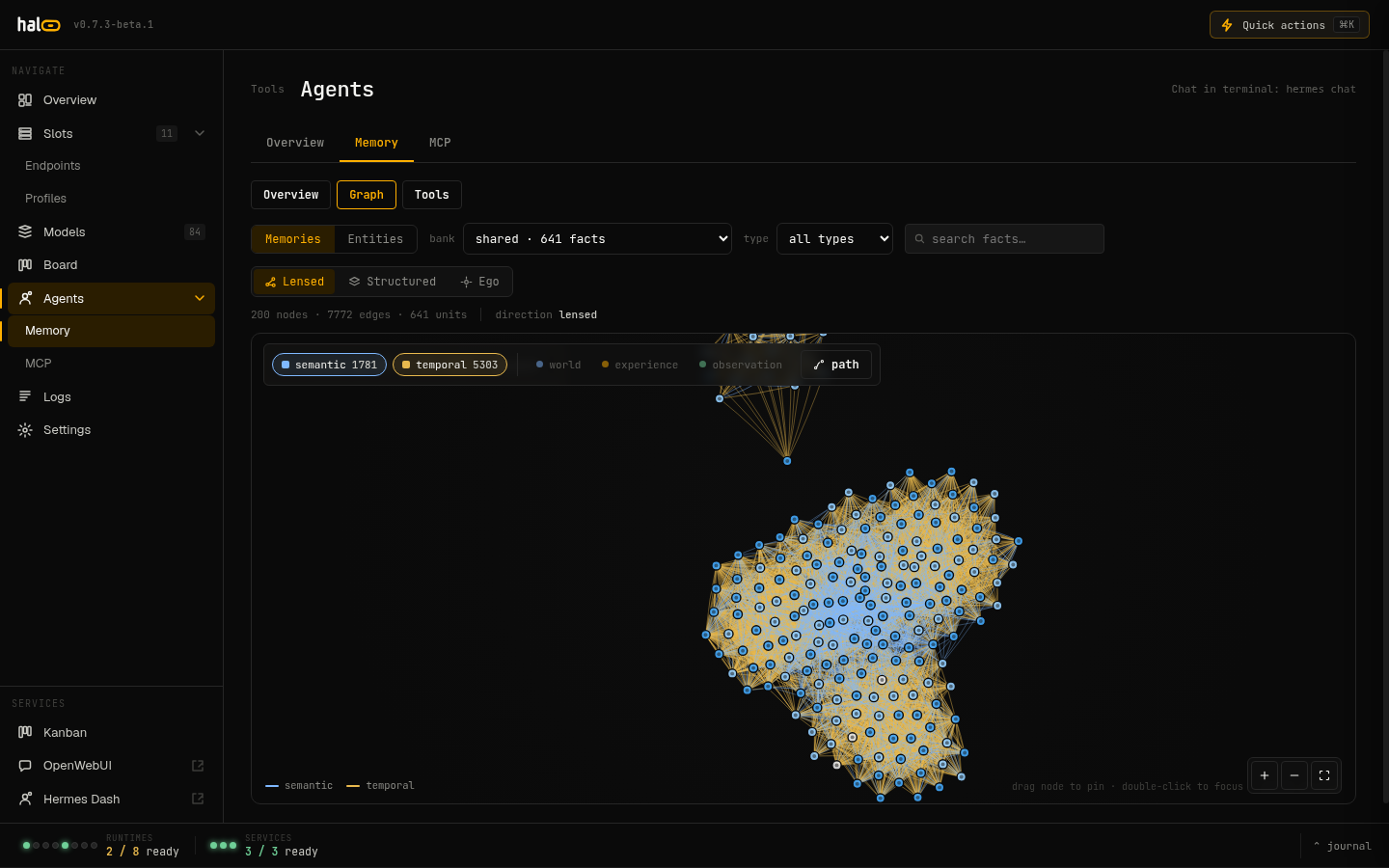 Memory — Hindsight facts and graph extraction. |
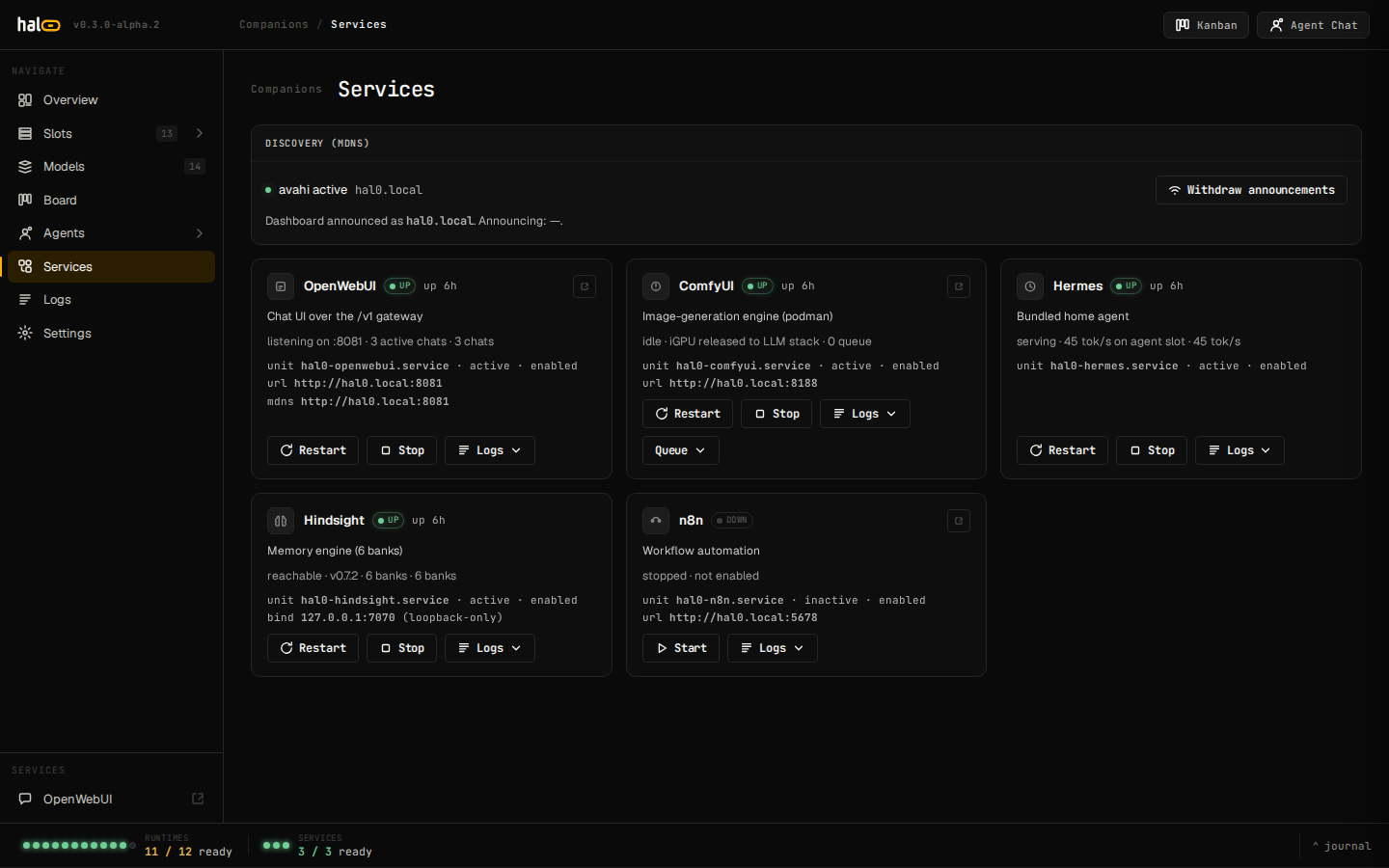 Services — Open WebUI, ComfyUI, Hermes, Hindsight, n8n with mDNS. |
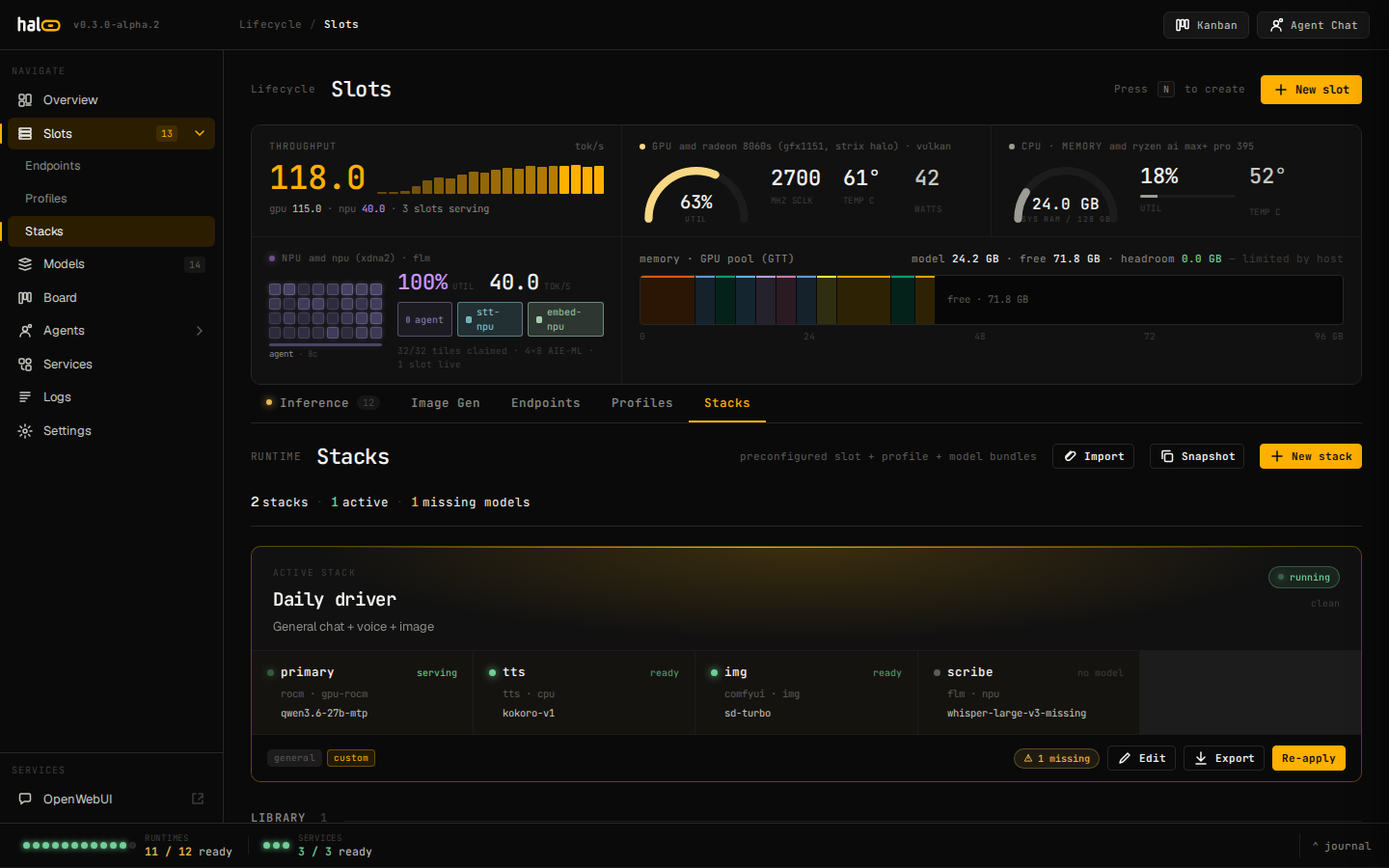 Stacks — declarative slot + profile + model bundles, applied atomically. |
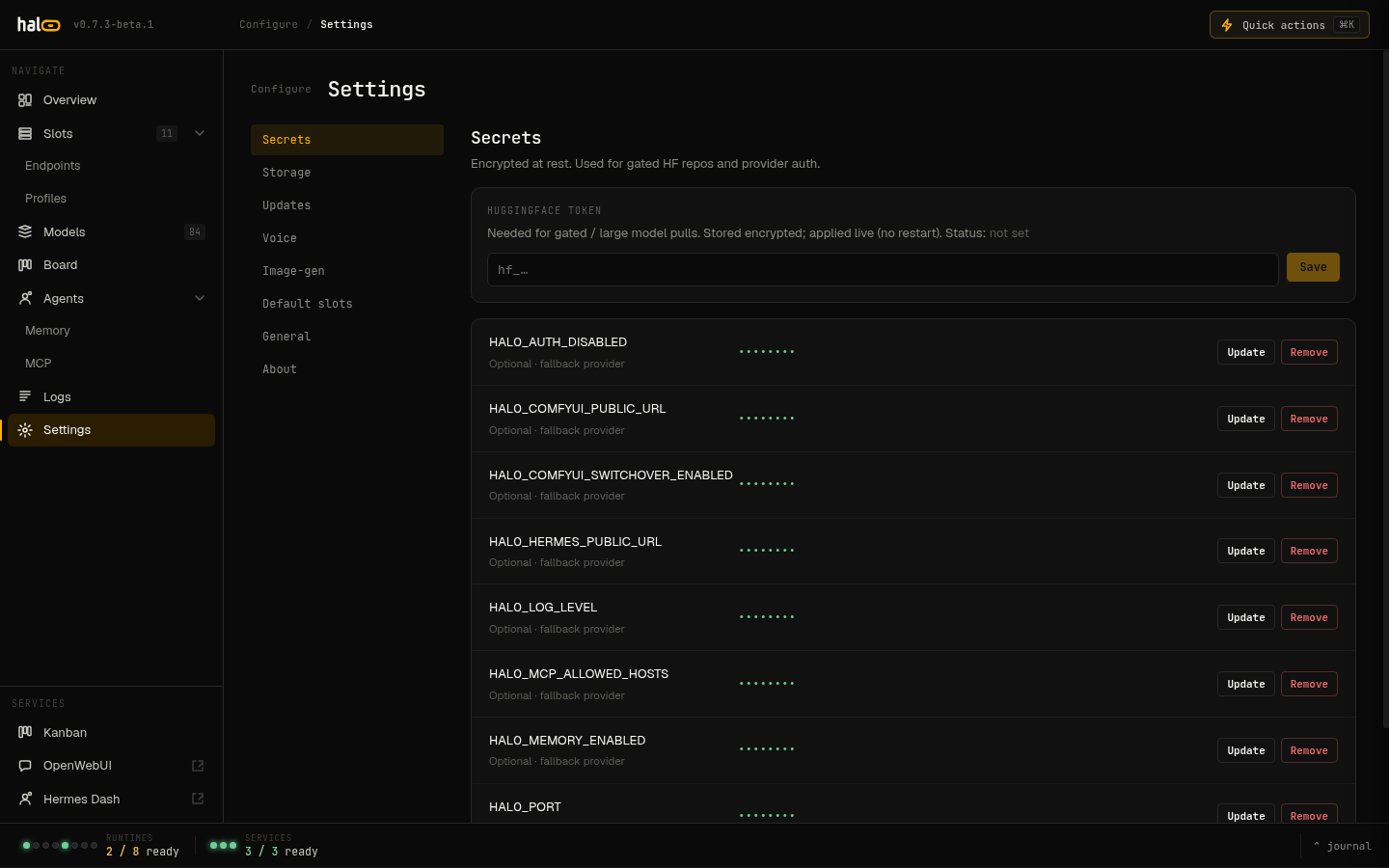 Settings — full hal0.toml parity with an Advanced section. |
More in the docs.
Strix Halo native, but not Strix-Halo-only. The probe is UMA-aware
on Strix Halo and falls back to portable parsers (/proc/cpuinfo,
/proc/meminfo, lspci) on every other host. The platform field on
/api/hardware resolves to one of strix-halo, wsl2, lxc,
proxmox-kvm, kvm, bare-metal-{nvidia,amd,intel}-gpu, or
bare-metal-cpu-only, and the dashboard only labels memory as
"unified" when it actually is. The slot-fit warnings size against the
real unified pool, not a BAR carve-out. The XDNA NPU is a first-class
device — opt-in even at Pro/Max tier, packing three model roles into
one process via the FLM trio (see below). 128 GB Ryzen AI Max+ 395 is
the reference deployment — not a hopeful port.
One control plane, six modalities, dedicated containers. Each
slot runs in isolation — chat, embed, rerank, STT, TTS, and image
generation each get their own podman container with its own image,
flags, port, and lifecycle. Concurrent workloads don't share a process
pool; they share only the GPU through the arbiter. Slot state is
persisted to /var/lib/hal0/slots/<name>/state.json and streamed via
SSE. Chat + embed alone sustains ~258 tok/s on Strix Halo at the
reference ROCm FP4 loadout.
NPU multi-role via the FLM trio. On Strix Halo with FastFlowLM
installed, a single FLM process inside the hal0-toolbox-flm container
hosts chat + transcription + embedding concurrently on the one AMDXDNA
hardware context — ~2 GB NPU memory, gemma3:1b at 40 tok/s +
Whisper-V3-Turbo + Embedding-Gemma all coresident. hal0 exposes this
as three slots (npu, stt-npu, embed-npu); the npu.toml
[npu] table toggles ASR and embed. The host-side FLM .deb is
installed for device-sanity probes only — inference runs in the
container. See ADR-0009 (FLM trio NPU packing) for why.
Dispatcher with single-flight + OmniRouter tool-calling. Registry-aware
routing across local slots and external upstreams (OpenRouter,
Anthropic, OpenAI, custom). The client-side OmniRouter loop provides
8 OpenAI tool-calling tools (image generation/editing, TTS,
transcription, vision, embed, rerank, route_to_chat) dispatched
through hal0 from any chat slot whose model carries the tool-calling
label. The set is filtered per request — a tool only appears in the
prompt if its target slot is enabled and its model carries the
required labels.
Reliability bar. Atomic env file writes. Schema-validated TOML.
Structured error envelopes ({"error":{"code":"slot.not_ready",...}}).
Cosign-verified self-update with one-flag rollback. Per-type LRU
concurrency with active-inference protection — a serving slot cannot
be evicted out from under a streaming request.
- OpenAI-compatible
/v1/*API — chat, completions, embeddings, rerank, audio transcriptions, audio speech, image generations, image edits, models. Drop-in for any OpenAI SDK; point your client athttp://localhost:8080/v1and go. - Slots — each named target in
capabilities.tomlcarries atype(llm | embedding | reranking | transcription | tts | image), adevice(gpu-rocm | gpu-vulkan | cpu | npu | img), amodel, plusenabledand optionaldefault. Eight seeded slots (agent,utility,embed,rerank,stt,tts,img,vision) plus NPU slots (npu,stt-npu,embed-npu) when FastFlowLM is installed. User-added slots viahal0 slot create NAME --type TYPE --model MODEL. Slots refer to a profile in/etc/hal0/profiles.tomlthat pins the container image + flag bundle for that backend. - Container runtime — each slot runs as its own podman container
under
hal0-slot@<name>.service.hal0-apion:8080is the control plane; slot containers bind loopback ports (8081–8099 + fixed seeds). No shared inference daemon. See docs/concepts/architecture.mdx. hal0 setupTUI — after install (or anytime),hal0 setupwalks you through storage, Extensions (Apps / Agents), Main and Agent model selection, and NPU opt-in, then downloads models with live progress. Non-interactive:hal0 setup --autoapplies recommended defaults without prompting. Other flags:--storage-dir PATH,--no-pull(seed slots without downloading models),--no-extensions. SetHAL0_SKIP_SETUP=1to skip first-run setup entirely during install.- Hardware-aware probe — detects GPU / NPU / unified memory,
writes
/etc/hal0/hardware.json, surfaces VRAM/RAM fit warnings inline in the slot form and duringhal0 setup. - Dispatcher — registry-aware routing, cold-cache prefetch, upstream fallback (OpenRouter, Anthropic, OpenAI, custom OpenAI-shaped endpoints). Mix local + remote per-model in one config.
- Dashboard — React 18 + Vite UI for slot/model management, hardware-aware configuration, live logs, system health, and a built-in chat page (with popout window + reasoning toggle). SSE-backed status + log tail. Journal panel streams per-slot container logs via journald. Dark by default. Live telemetry — Power & Thermal (GPU clock/temp/power) and Per-Slot Throughput — is on by default, and the logs/events surface is unified across channels with real source/slot attribution. The slots page splits into Inference | Image Gen tabs: the Image-Gen tab operates the ComfyUI container (live GTT/RAM gauges, queue depth, model inventory) with a gated inference ⇄ generation iGPU switchover behind a blast-radius confirm.
- Extensions — selectable Apps (Open WebUI) and Agents (Hermes,
Pi) that
hal0 setupauto-wires into the platform. - Companion-service management —
/api/servicesis the declarative source of truth for OpenWebUI, Hermes, Hindsight, ComfyUI, and n8n: audit-logged systemd lifecycle actions (start/stop/restart/enable/ disable), mDNS.localadvertisement, and a dedicated dashboard Services page. - Stacks — declarative, runtime-switchable model/slot layouts as a
replacement for install-time bundle tiers. A
StackConfigis planned into a change set, applied atomically (with rollback) and converged against the live slot set; drift is detected by content hash. Stacks export/import via a checksummed.hal0stack.jsonenvelope, and a live config can be snapshotted back into a Stack. - OpenWebUI prewired — chat at
:3001, zero config. The installer writesopenwebui.envpointing at the local hal0 API. - OmniRouter (8 tools) —
generate_image,edit_image,text_to_speech,transcribe_audio,analyze_image(vision),embed_text,rerank_documents,route_to_chat. Dispatched client-side from chat slots; dynamically filtered per request. - Image generation, day one —
POST /v1/images/generationsvia ComfyUI in theimgslot container (ROCm).hal0 setuplets you select image-gen as part of the initial configuration. - Atomic self-update with rollback —
hal0 update --channel stable|nightly. Cosign-verified tarballs swap a/usr/lib/hal0/currentsymlink;--rollbackreverts. - One-line install —
curl -fsSL https://hal0.dev/install.sh | bashwrites the first-run sentinel and wiring automatically — no model picks, no download, no interaction needed. Runhal0 setupafterward to choose models and configure apps and agents. (--models-dir=PATHorHAL0_MODELS_DIR=PATHredirects model pulls off/var/lib/hal0/models). The bootstrap fetches the release manifest, sha256-verifies the tarball, cosign-verifies the signature against the workflow OIDC identity, then hands off toinstaller/install.sh. - One-line Proxmox VE install — on a Proxmox host,
bash -c "$(curl -fsSL https://raw.githubusercontent.com/Hal0ai/hal0/main/scripts/proxmox-ve/hal0.sh)"creates an unprivileged Debian 13 LXC and runs the standard bootstrap inside it.--advancedopens whiptail prompts; every parameter has an env-var override (CTID,RAM_MB,STORAGE, …). Hardware-agnostic — Strix Halo passthrough still requires the privileged-LXC recipe. Seescripts/proxmox-ve/README.md.
hal0 ships two MCP servers and one bundled agent app. The MCP
servers (/mcp/admin for slot / model / capability / config / hardware
/ log admin and /mcp/memory for Hindsight-backed long-term memory) are
reachable by any MCP-speaking client — Claude Code, future RAG
services, external scripts. The bundled agent is single-pick at install:
pi-coder (CLI shape, installed from Hal0ai/pi-mono fork via
@earendil-works/pi-coding-agent on npm) or Hermes-Agent (service
shape, installed via the hal0-owned hermes wrapper — hal0-hermes is
kept as a back-compat symlink; connects to
hal0-api via HAL0_INFERENCE_BASE=http://127.0.0.1:8080). Select
one during hal0 setup (Extensions step) or any time via hal0 agent install <name>; swap atomically with --switch. Capital-D destructive MCP calls
(model_pull, slot_delete, config_write, etc.) gate through a
header bell + inbox modal in the dashboard, with CLI parity via
hal0 agent approvals {list,approve,deny}. See
docs/concepts/agents.mdx,
docs/reference/mcp-tools.mdx, and
docs/guides/run-agents.mdx.
Each capability runs in its own container, supervised by
hal0-slot@<name>.service. The profile in /etc/hal0/profiles.toml
pins the container image and flag bundle for each backend.
| Capability | Profile / image | Device | Notes |
|---|---|---|---|
| chat + embed + rerank | rocm / rocm-dnse / rocm-moe / vulkan / cuda (experimental) |
ROCm / Vulkan / CUDA / CPU | ROCm FP4 fork baked into the image; MTP via --spec-type draft-mtp on the rocm-dnse/rocm-moe profiles |
| chat + STT + embed (NPU) | flm (hal0-toolbox-flm) |
AMD XDNA (opt-in) | FLM trio: one container, [npu] asr/embed toggles, ~2 GB NPU mem |
| transcription | whisper.cpp in toolbox image | Vulkan / CPU | stt slot |
| TTS | tts (hal0-toolbox-kokoro) / tts-qwen3 (hal0-toolbox-qwen3tts) |
CPU / ROCm | voice.tts switches Kokoro (CPU) ⇄ Qwen3-TTS (GPU) without reconfiguring the slot |
| image | comfyui (docker.io/kyuz0/amd-strix-halo-comfyui) |
ROCm | Exclusive GPU via arbiter; SD Turbo / Flux-2-Klein-9B |
The NPU path is opt-in: the installer places a FastFlowLM .deb on
the host for device-sanity probes (flm validate); inference runs
inside the hal0-toolbox-flm container image. With FLM present,
hal0 setup surfaces the NPU trio opt-in during setup.
For the container-runtime operator reference — service layout, slot TOML fields, profiles, GPU arbiter, and day-2 commands — see docs/concepts/architecture.mdx and docs/guides/manage-slots.mdx.
Linux + systemd is the only hard requirement
(installer/install.sh:246). macOS and Windows
are not in scope for v1.
| Tier | Hardware | Status |
|---|---|---|
| First-class | AMD Ryzen AI Max+ 395 ("Strix Halo") with iGPU + XDNA NPU + 128 GB unified | Reference deployment. All published perf numbers come from this box. |
| First-class | AMD Ryzen AI Max 385 / 390 with 64 GB unified | Same path; small + mid tiers fit, 70B Q4 with shorter context. |
| Experimental | NVIDIA RTX 30/40/50 (10–32 GB) | Dedicated cuda seed profile — upstream ghcr.io/ggml-org/llama.cpp:server-cuda via CDI (nvidia-container-toolkit), with multi-GPU gpu_index pinning on the gpu-cuda device. Auto-falls back to the vulkan profile when CDI isn't present. /api/backends doesn't yet auto-advertise gpu-cuda. |
| Supported | AMD Radeon RX 7000 / discrete (16–24 GB) | ROCm or Vulkan container profiles; same hal0-slot@<name> lifecycle. |
| Fallback | CPU-only x86_64 | cpu-llm profile — the Vulkan toolbox image run CPU-only (no GPU passed to the container). Usable for tiny models / smoke tests, not the headline experience. |
hal0/
├── src/hal0/         # Python package (FastAPI API + capability layer + ContainerProvider + CLI)
│   ├── providers/    # ContainerProvider, FLMProvider, ComfyUI, etc.
│   ├── slots/        # slot manager, state machine, GpuArbiter
│   └── omni_router/  # client-side tool-calling loop + tool definitions
├── ui/               # React 18 + TypeScript + Vite + Tailwind 4 dashboard (v3)
├── installer/        # install.sh (writes /etc/hal0/, systemd units, hal0-api.service)
│   ├── etc-hal0/     # seed slot TOMLs + profiles.toml
│   └── systemd/      # hal0-agent@ template units
├── tests/            # pytest suite (α unit, β integration, γ release-gate)
├── docs/             # user docs (mirror of hal0.dev/docs); dev docs under docs/internal/
└── PLAN.md           # roadmap + history
The model catalog lives at /var/lib/hal0/registry/registry.toml —
the single source of truth for HuggingFace coordinates, SHA-256
digests, and curated filenames. Per-leaf symlinks under the models
directory redirect to /mnt/ai-models/ when a separate storage
volume is in use.
# backend
python -m venv .venv && source .venv/bin/activate
pip install -e ".[dev]"
hal0 serve --reload

# frontend
cd ui
npm install
npm run dev
The API lives at http://127.0.0.1:8080, the dashboard at the Vite dev
server URL (usually http://127.0.0.1:5173).
Run hal0 doctor any time to re-check pre-flight (systemd / python /
disk / ports / NPU probe). hal0 model pull <ref> streams models from
Hugging Face into registry.toml under the user.* namespace — a
disk-space preflight fails fast before a multi-GB pull, and an
interrupted pull resumes via HTTP Range instead of restarting from
zero — and hal0 uninstall [--keep-data] tears down a running install (thin
wrapper over installer/uninstall.sh).
Useful day-2 commands:
# service status
systemctl status hal0-api
systemctl list-units 'hal0-slot@*'

# logs
journalctl -fu hal0-api
journalctl -fu 'hal0-slot@*'

# restart a wedged slot container
systemctl restart hal0-slot@agentPer ADR-0012 (remove auth and Caddy entirely, supersedes
ADR-0001), hal0 ships with no built-in auth and no bundled TLS.
hal0-api binds 0.0.0.0:8080 and treats every request as
authenticated by virtue of network reachability — the right posture
for a homelab appliance on a trusted LAN.
If hal0 is reachable from anything you don't physically control,
front it with an upstream reverse proxy that owns auth + TLS — Traefik,
nginx, Cloudflare Tunnel, or your own preferred edge. See
docs/concepts/security.mdx for example configs
of each.
If hal0 runs inside a Proxmox LXC, the container only sees its own
cgroup slice of memory — other tenants, ZFS ARC, and the host kernel
draw from the same physical DIMMs as GPU GTT but are invisible from
inside. To surface that, drop a read-only PVEAuditor API token into
the dashboard's Settings → "Proxmox integration" panel. Once saved,
the unified-memory bar swaps to the physical host's DIMM total and
adds a muted "Proxmox host" segment for other-tenant + kernel
pressure. Token is sensitive and stored 0600 at
/etc/hal0/proxmox.json; the API never echoes it back. Bare-metal and
VM installs leave the panel off and the dashboard stays quiet.
No dates — items are direction. The closer to the left, the closer to running on your box. Full version at hal0.dev/#roadmap.
- Dashboard redesign + live telemetry header — fixed-band layout with a unified-memory hero, and a combined throughput / GPU / CPU / NPU-occupancy metrics card that reads only from live probes
- Companion services, one surface — Open WebUI, ComfyUI, Hermes, Hindsight, and n8n managed from a dashboard Services page with mDNS discovery and allow-listed lifecycle actions
- GPU generalization — experimental CUDA + per-slot
gpu_indexpinning for multi-GPU hosts, alongside the ROCm/Vulkan defaults - Virtual seed profiles — code-defined and self-healing on upgrade, with dedicated embed/rerank lanes and a model×profile×slot MTP decision (tri-state Auto/On/Off)
hal0 mcpCLI + two-way MCP — manage MCP servers from the CLI; hal0 hosts admin + memory servers and reaches external ones- Per-slot podman containers — every inference workload runs in
its own
hal0-slot@<name>.servicecontainer;ContainerProvider+profiles.tomlreplace the old single-daemon model (epic #652, extraction #687, PRs #688–#726) - GpuArbiter exclusive image mode — ComfyUI gets the iGPU to itself; LLM GPU slots pause and resume automatically
- NPU trio via
hal0-toolbox-flmcontainer — FLM trio now runs containerised; host FLM.debis probe-only registry.tomlas sole model catalog — no secondary runtime catalog to sync;hal0 modelcommands and the dashboard are the only safe edit paths- Slot-state Prometheus + EventBus journal — per-slot observability
via journald (
hal0-slot@<name>) and the dashboard Journal panel - FLM trio NPU packing — chat + ASR + embed coresident on one
AMDXDNA hardware context; toggle via
[npu]in the slot TOML - OmniRouter client-side tool-calling — 8 tools, dynamic
per-request filtering,
route_to_chatcross-slot delegation hal0 setupTUI — replaces the web FirstRun picker; the installer seeds no model picks (--auto --no-pull --no-slots); the interactive post-install flow covers storage, Extensions, models, and NPU opt-inhal0 registry import— one-shot v0.1.x → v0.3 registry recovery from a backup tarball- Carried forward: OpenAI-compatible
/v1/*, portable hardware probe, capability slots + orchestrator, dispatcher with single-flight + cold-cache prefetch, bundled OpenWebUI on:3001, cosign-keyless self-update with rollback, bundled agents (pi-coder / Hermes-Agent) + MCP admin + Hindsight memory MCP
- Federated memory — recall across local + remote sources behind one memory surface (the MCP-client side shipped in v0.9)
- Benchmarks & presets UI — in-dashboard tok/s + latency runs, plus curated loadout presets you can flash onto a fresh install
- AUR PKGBUILD & Ubuntu PPA — native distro packages on top of the install script; pacman and apt as first-class install paths
- Light mode toggle
- Multi-host federation — a slot mesh across LAN boxes — primary
on the Strix Halo, embed on the workstation, all behind one
/v1/*surface - Fine-tune & LoRA hot-swap — attach and rotate LoRAs against a warm base model without unloading the underlying weights
- Per-model rate limits & budgets — cost-style accounting for local inference — cap a chatty agent without taking the whole box down
- ChatOps adapters — Slack and Matrix bridges as extensions — talk to hal0 from the rooms you already live in
Apache 2.0. See LICENSE.
The contribution model is still being decided
(PLAN.md §16). File issues for discussion; PRs aren't
being accepted from outside contributors yet. See
CONTRIBUTING.md for the test tiers and the
eventual flow. For questions and general chat, join the
hal0 Discord.
This project adheres to the Contributor Covenant
code of conduct. To report a security vulnerability, see
SECURITY.md.