Tagged Contracts imagines a composable metadata layer where free-form information can be stored on the blockchain in a consistent way that is easy for developers and users alike. Think: Docker tags, for smart contracts.
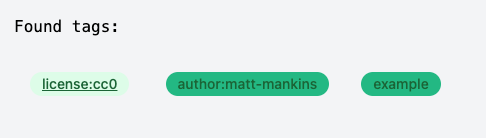
        // inside your contract / NFT

contract ExampleTaggedContract is Tagger {
    constructor() {
        // setup our public tags and responding refs
        // recommend using a : as delimeter of hierarchies
        setTag("license:cc0", "0x04943a8D464aC4f988453FD3690C85A6CEb2C66c"); // reference to more info
        setTag("author:matt-mankins"); // simple tag
        setTag("Example"); // simpler tag :), stored as lowercase

        // externally: get all with jsonTags()
        // internally: existsTag(tag) or getTagRef(tag)
    }
}
The initial motivating use case is to provide a uniform way to add license information to NFTs to help answer questions like "What rights do I have if I own this NFT?".
There have been numerous attempts to standardize and clarify licensing rights for NFTs, however there remains a lack of consensus on how to locate the license for an NFT.
We are inspired by conversations we have had with the Creative Commons organization, as well as existing work such as the Royalties Registry and EIP-2981 which we implemented when we created our own NFT, Kevin the Balloon.
Incidentally, the term blessed is inspired by Perl's blessed refererents which is inspirational for this design too.
We also imagine that applications like Etherscan could use our tagging feature to display the properties of contracts instead of requiring manual configuration of labels.
We use the term "referential attributes" to include data whose source is defined by another address. We call this referred address the Blessed Tag. Contracts that implement this protocol will define their tags in a unique mapping namespace–for instance a Tag may represent a License, Entitlement, Description, or some other "thing".
Tags are defined in a top-level contract map, whose keys are set by convention, and could grow in a fashion similar to the Service Name and Transport Protocol Port Number Registry used for TCP/UDP ports. Values are maps themselves and include at least an address and type field.
We could follow through with the approach outlined in the "NFT Licensing Protocol Idea" and reach a good approximate solution to answer the question "What License does this NFT have?".
Yet we question if a more general solution is needed that transcends the specifics of licensing and instead allows for the creation of a general-purpose tangential attribute store that could then be used to store license data.
By using the general purpose data structure and taxonomy conventions we imagine that contract authors facilitate the creation of an ecosystem of referential attribute data stored on the blockchain. Essentially this turns a blob of data into a typed data.
We considered an approach similar to EIP-165 where the hash of attributes dictated an agreed-upon definition of the attribute. Yet these are more difficult to create than merely setting a string value. Indeed EIP-1616 attempted to do something similar but ultimately the approach was abandoned.
Instead, we chose to fix the place where tags live within the contract, relying on convention of attribute names. This allows for colon delimited taxonomies, like {license:cc0, contact:email, or type:nft} which can have domain-specific fields–ideally kept to the absolute minimum. Each of these tags can then optionally include an address, the referential address or the Tag, which has more information.
We can then provide consistent functions to answer common use cases:
- "What license is this contract covered by?"
- "What third parties can I go to if I need support?"
We recommend that Tag Contracts be deployed as a Proxy Contract to allow the definition of the Tag–for example the Creative Commons License, v0–to evolve over time. Should a contract wish to refer to a non-malleable definition for a Tag, it would simply refer to a fixed, non-upgradable contract.
Contract deployers can use a associate() function on Tag Contracts to show that they support a given Thing. This reverse-map can be used to power user-interfaces to prove connections between parties. A double-opt-in could be imagined where the Tag Contract executes an confirmAssociation() function on the child contract.
It should be noticed that Tag Contracts are completely optional and use-case dependent.
Contracts can add tag support with:
import "./tags/Tagger.sol"; // todo: library on npm

contract ExampleTaggedContract is Tagger {
    constructor() {
        // setup our public tags and responding refs
        // recommend using a : as delimeter of hierarchies
        setTag("license:cc0", "0x04943a8D464aC4f988453FD3690C85A6CEb2C66c"); // reference to more info
        setTag("author:matt-mankins"); // simple tag
        setTag("Example"); // simpler tag :), stored as lowercase

        // externally: get all with jsonTags()
        // internally: existsTag(tag) or getTagRef(tag)
    }
}
You would configure any setTag as needed, for instance setTag("example").
Tag "makers" can then then create smart contracts that adhere to the Tag Contract Protocol like the following which will provide interfaces for end users and other contracts to query about the tag.
import "./tags/Tag.sol"; // would be library on npm

/*
 * This creates an example contract which can be queried to get "more info" about a tag.
 * Also called the "Tag Reference" this contract is a place to go to get more information.
 */
contract ExampleCC0Tag is Tag {

    constructor(string memory _tag) {
        // create the tag reference
        // Tag License = new Tag(_tag);
        // license = address(License); // for testing
        tag = _tag;

        // a readme provides a basic overview and should be included
        setTagReadme(
            "This tag refers to the Creative Commons CC0 License.\n"
            "CC0 (aka CC Zero) is a public dedication tool, which allows creators to give up their copyright and put their works into the worldwide public domain. CC0 allows reusers to distribute, remix, adapt, and build upon the material in any medium or format, with no conditions."
            "More information at https://creativecommons.org/share-your-work/public-domain/cc0/"
        );

        // these are optional, but could be useful to allow more granular querying
        setTag(
            "url",
            "https://creativecommons.org/share-your-work/public-domain/cc0/"
        );
        setTag("contact", 'Info <info@creativecommons.org>'); // more info
        setTag("description", "creative commons v0 license");
        setTag("isa", "license");
        // ... and add more if needed...

        // Claims: Have your contract buy a license here by "buying a claim"

        // enable claims to allow contracts to "purchase" the thing.
        activateClaims(true);
        setTagClaimPrice(0.001 ether);

        // optional, setTagup a readme to show for people wanting info on claim purchase
        setTagClaimReadme(
            "Claims are available and entitle you to a license.\n"
            "Details may apply, please check our website for more information."
        );
    }
}
- Matt Mankins = matt@loremlabs.com.
% npm run test