


Q2NSViz is a desktop companion for Q2NS that replays JSON trace files into an interactive, time-stepped view of quantum network protocols: physical and entanglement-connectivity graphs rendered jointly, with support for entangled-state manipulations. More details can be found in our documentation and related works!
Q2NS and its companion tool Q2NSViz are developed within the ERC-CoG QNattyNet project (grant n. 101169850) at the University of Naples Federico II, funded by the European Research Council.
- Time-step replay — scrub forward and backward through the simulation timeline with transport controls
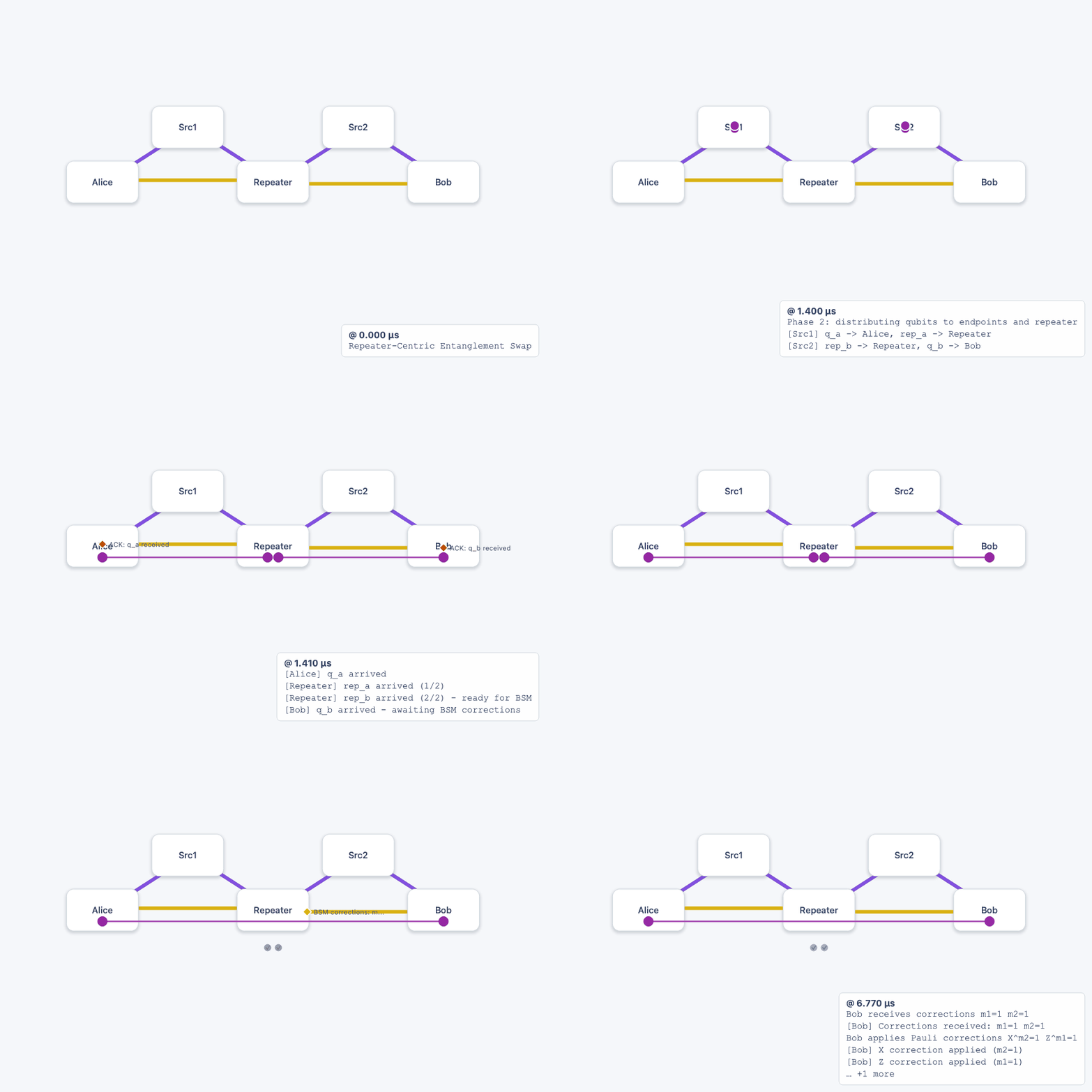
- Network canvas — QPainter-rendered topology showing nodes, qubits (color-coded), in-flight transfers, and channel kinds
- Entanglement graph — live view of the entanglement graph including graph-state measurements and local complementations
- Charts panel — time-series plots of live qubits, entangled states, and cumulative measurements, plus a per-node qubit distribution, updated along the timeline
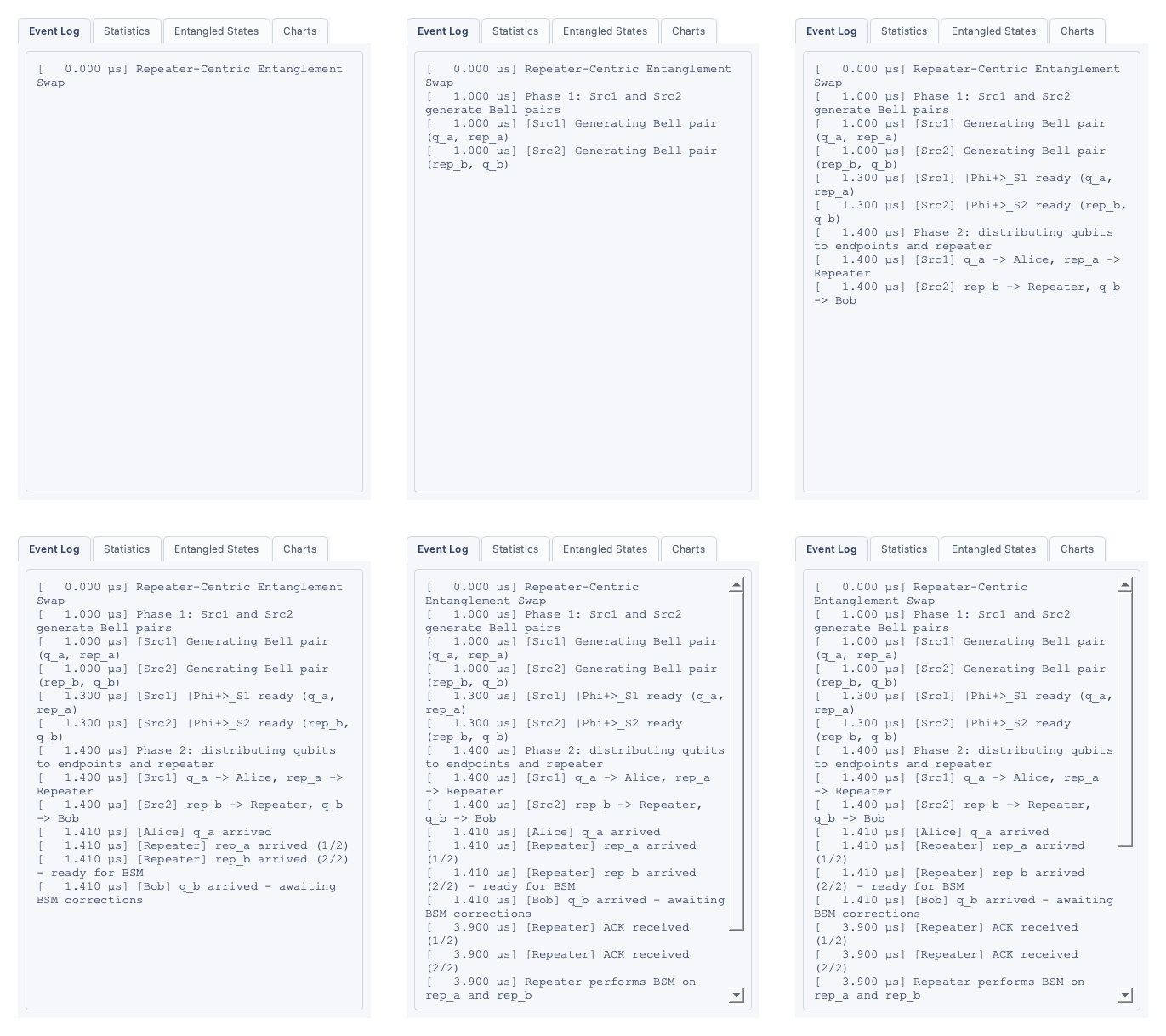
- Event log — list of
traceTextprotocol messages emitted by the simulation
The viewer is built with PyQt6 for the GUI and Matplotlib for the charts. Clone the repository and install with pip:
git clone https://github.com/QuantumInternet-it/q2nsviz.git
cd q2nsviz
pip install .
This pulls in the dependencies and installs a q2nsviz launcher command. For development, use an editable install with the test extras instead:
pip install -e ".[test]"Note
Q2NSViz has been tested and is recommended for use with Python 3.12; other versions may require minor adjustments. Use an isolated environment (venv or conda) to avoid dependency conflicts.
Once installed, launch the viewer with the q2nsviz command:
# Open the viewer (no trace loaded)
q2nsviz

# Load a trace file on startup
q2nsviz q2nsviz/example_traces/q2nsviz-teleportation-example.json

# Set log verbosity (DEBUG, INFO, WARNING, ERROR, CRITICAL; default: WARNING)
q2nsviz --log-level DEBUG
Tip
Running from a clone without installing? Use python -m q2nsviz in place of q2nsviz with the same arguments.
Use the Load Simulation button in the top bar to open a trace at any time. The file dialog opens in the bundled example traces by default. They ship as package data, so the same folder is found whether you run from a clone, an editable install, or a wheel.
The q2nsviz/example_traces/ directory contains ready-to-load traces:
| File | Protocol |
|---|---|
q2nsviz-teleportation-example.json |
Quantum teleportation |
q2nsviz-graphstate-gen-example.json |
Graph-state generation and measurement |
q2nsviz-entanglement-distribution-example.json |
Entanglement distribution |
q2nsviz-repeater-swap-example.json |
Entanglement swapping (1 repeater) |
q2nsviz-channel-loss-example.json |
Lossy quantum channel |
The repeater-swap example replayed in the viewer — network canvas and event log:
Q2NSViz reads the JSON format emitted by Q2NS, in either NDJSON (one event object per line — the form used by the bundled examples) or JSON-array form; the format is auto-detected on load. A minimal NDJSON trace looks like this:
{"type": "createNode", "t_ns": 0, "label": "Alice", "x": 25, "y": 50}
{"type": "createNode", "t_ns": 0, "label": "Bob", "x": 75, "y": 50}
{"type": "createChannel", "t_ns": 0, "from": "Alice", "to": "Bob", "kind": "quantum"}
{"type": "createQubit", "t_ns": 1000, "label": "q0", "node": "Alice"}
{"type": "createQubit", "t_ns": 1000, "label": "q1", "node": "Alice"}
{"type": "entangle", "t_ns": 1300, "duration_ns": 300, "bits": ["q0", "q1"]}
{"type": "sendQubit", "t0_ns": 1400, "t1_ns": 1500, "bit": "q1", "from": "Alice", "to": "Bob"}
{"type": "traceText", "t_ns": 1500, "node": "Bob", "text": "q1 arrived - Bell pair shared"}
{"type": "measure", "t_ns": 2100, "duration_ns": 100, "bit": "q0", "base": "Z"}
{"type": "removeQubit", "t_ns": 2100, "bit": "q0", "reason": "discarded"}
The supported event types are:
| Event type | Required fields | Description |
|---|---|---|
createNode |
t_ns, label, x, y |
Define a network node; x and y are canvas percentages (0–100); always emitted with t_ns = 0 |
createChannel |
t_ns, from, to, kind (quantum|classical) |
Add a channel between two nodes |
createQubit |
t_ns, label, node |
Instantiate a qubit on a node |
createCbit |
t_ns, label, node |
Instantiate a classical bit on a node |
entangle |
t_ns, bits (array) |
Mark a set of qubits as entangled; a second entangle event on the same set cancels the edge (e.g. CZ² = I) |
sendQubit |
t0_ns, t1_ns, bit, from, to |
Transfer a qubit through a quantum channel |
sendCbit |
t0_ns, t1_ns, bit, from, to |
Transfer a classical bit through a classical channel |
sendPacket |
t0_ns, t1_ns, from, to, label [, protocol] |
Classical packet in flight; protocol is optional ("tcp" or "udp") and controls the packet color in the visualizer |
measure |
t_ns, bit, base |
Projective measurement; removes the qubit's entanglement edges. base is informational — use graphMeasure for basis-dependent updates |
graphMeasure |
t_ns, bit, base, supportNode (optional) |
Graph-state measurement; supportNode is the neighbour of bit that drives the X-basis local-complementation sequence |
removeQubit |
t_ns, bit, reason (optional) |
Remove a qubit — silently when reason is "discarded", as lost (red ✕) otherwise; removals co-occurring with a measure are never shown as lost |
removeCbit |
t_ns, bit |
Remove a classical bit that is no longer needed |
traceText |
t_ns, text, node (optional) |
Protocol log message |
entangle, measure, and graphMeasure accept an optional duration_ns giving the operation's processing time. Events are emitted at operation completion: the state transition commits at t_ns, and a processing ring is drawn during the preceding [t_ns - duration_ns, t_ns) — dashed for entangle, solid for measure, double for graphMeasure.
Tip
Without duration_ns the transition is instantaneous at t_ns.
Every event line describes something that has already happened: t_ns is the instant its state change commits.
- Gate times — durationed events are emitted at completion; the ring covers the preceding
[t_ns - duration_ns, t_ns). Anything that uses the result is simply stamped at or aftert_ns. - Propagation —
sendQubit/sendCbit/sendPacketcarry explicitt0_ns/t1_nsand are emitted at departure. The carrier animates over the window and sits at its destination fromt1_nson.
In Q2NS this is one pattern — schedule the completion, log there. The Bell-state measurement in the bundled repeater-swap example:
// We schedule something to happen after a processing time
Simulator::Schedule(kTwoQGate, [&]() {
  auto [m1, m2] = repeater->MeasureBell(memA, memB);
  // commit now, ring back-dated kTwoQGate
  TraceMeasure("rep_a", kTwoQGate, "Bell");
  TraceMeasure("rep_b", kTwoQGate, "Bell");
  // swapped pair, instantaneous commit
  TraceEntangle({"q_a", "q_b"});
  // ... send the corrections carrying m1, m2 ...
});
yields the trace:
{"type": "measure", "t_ns": 4200, "duration_ns": 300, "bit": "rep_a", "base": "Bell"}
{"type": "measure", "t_ns": 4200, "duration_ns": 300, "bit": "rep_b", "base": "Bell"}
{"type": "entangle", "t_ns": 4200, "bits": ["q_a", "q_b"]}
The measurement rings run during [3900, 4200); the swapped entanglement edge lands exactly when the BSM completes.
Note on BSM and entanglement swapping. Measuring a qubit (via
measure) removes all its entanglement edges — no new entanglement is inferred from measurement outcomes. For entanglement-swapping protocols (e.g., repeater chains), Q2NS should emit an explicitentangleevent for the newly swapped pair after the BSM; the BSM alone does not update the entanglement graph.
The replay engine (q2nsviz/logic.py) is Qt-free and can be used directly from Python scripts, independently of the GUI — importing q2nsviz never loads Qt. load_events() accepts a trace-file path (or a pre-parsed event list), and snapshot_at(t_ns) reconstructs the network state at any simulation time as an immutable Snapshot:
from q2nsviz import SimulationStateManager

sm = SimulationStateManager()
sm.load_events("q2nsviz/example_traces/q2nsviz-repeater-swap-example.json")

snap = sm.snapshot_at(4000)            # state at t = 4 µs, mid-BSM
print(sorted(snap.live_qubit_labels))  # ['q_a', 'q_b', 'rep_a', 'rep_b']
print(snap.entangled_states)           # {'q_a': ('q_a', 'rep_a'), 'q_b': ('q_b', 'rep_b')}
print(sorted(snap.measuring_qubits))   # ['rep_a', 'rep_b']
Tip
A Snapshot carries the node/channel topology, the qubit and classical-bit registries, the entanglement graph and its connected components, the measured/removed/lost sets, and the in-flight and operation-window sets — see the Snapshot docstring for the full field list.
Pre-commit runs ruff for linting, import sorting, and formatting on every commit.
pip install ruff pre-commit
pre-commit install
Run the hooks manually with pre-commit run --all-files, or invoke ruff directly with ruff check --fix . and ruff format ..
The test suite covers the trace parser, the quantum-state replay engine, and the bundled example traces.
pip install pytest pytest-qt
pytestThe API reference is generated with Doxygen (with Graphviz for the class and call diagrams). On macOS: brew install doxygen graphviz. Then run:
doxygen .doxygen/DoxyfileThe HTML site is written to .doxygen-build/html/; open .doxygen-build/html/index.html in a browser. Generated output is not committed to the repository.
The same build is published to GitHub Pages by .github/workflows/docs.yml on every push to main (once the repository is public, with Pages set to build from GitHub Actions).
q2nsviz/
  __init__.py             # Public API — the Qt-free replay engine
  __main__.py             # `python -m q2nsviz` entry point
  cli.py                  # Argument parsing; backs the `q2nsviz` console script
  logic.py                # Trace parser and quantum state replay engine
  example_traces/         # Sample JSON traces, shipped as package data
  ui/
    window.py             # QMainWindow, playback controller, and main() launcher
    canvas.py             # Network topology renderer (QPainter)
    charts.py             # Matplotlib time-series charts
    panels.py             # Control panel and info tabs
    theme.py              # Shared colors and fonts
test/                     # Pytest suite: parser, state engine, charts, examples
doc/                      # Doxygen mainpage, API-doc sources, README assets
pyproject.toml            # Project metadata, ruff and pytest configuration
requirements.txt          # Runtime dependencies
MANIFEST.in               # Source-distribution packaging rules
CITATION.cff              # Citation metadata
LICENSE                   # MIT license
.pre-commit-config.yaml   # Pre-commit hook definitions
.doxygen/                 # Doxyfile, HTML theme, and documentation assets
.github/workflows/        # CI: builds and publishes docs to GitHub Pages
Q2NSViz, like Q2NS, is developed by our Quantum Internet Research Group team, under the ERC-CoG QNattyNet project.
Thank you to all the researchers who have helped develop Q2NS and Q2NSViz!

|

|

|
Q2NSViz is and will remain free, open-source software. We are committed to keeping it open and actively maintained for the quantum networking research community.
To support this endeavor, please consider:
- Starring and sharing the repository: https://github.com/QuantumInternet-it/q2nsviz
- Contributing code, documentation, tests, or examples via issues and pull requests
- Citing Q2NS and Q2NSViz in your publications (see Cite This)
- Sharing feedback and use cases with the team
If you use Q2NSViz in your research, please cite our reference paper: Q2NSViz: An Open-source Standalone Visualizer for Quantum Network Simulations (submitted)
You can use the GitHub "Cite this repository" button (top-right of this page) for a ready-to-use citation in multiple formats, or use the BibTeX entry below:
@article{q2nsviz-2026,
  title  = {{Q2NSViz: An Open-source Standalone Visualizer for Quantum Network Simulations}},
  author = {Mazza, Francesco and Caleffi, Marcello and Cacciapuoti, Angela Sara},
  year   = {2026},
  note   = {Submitted for publication}
}
You may additionally cite the software itself. It is archived on Zenodo under a DOI that always resolves to the latest release (10.5281/zenodo.21216676):
@software{q2nsviz-software,
  title     = {{Q2NSViz: Quantum Network Trace Visualizer}},
  author    = {Mazza, Francesco and Caleffi, Marcello and Cacciapuoti, Angela Sara},
  year      = {2026},
  version   = {0.1.0},
  doi       = {10.5281/zenodo.21216676},
  publisher = {Zenodo},
  url       = {https://doi.org/10.5281/zenodo.21216676}
}Q2NSViz is released under the MIT License.
The following papers present the Q2NS and Q2NSViz tools, or motivate the research behind them. If your work belongs here, please open an issue or pull request.
[1] Quantum Internet Architecture: Unlocking Quantum-Native Routing via Quantum Addressing (invited paper). Marcello Caleffi and Angela Sara Cacciapuoti — IEEE Transactions on Communications, vol. 74, pp. 3577–3599, 2026.
[2] An Extensible Quantum Network Simulator Built on ns-3: Q2NS Design and Evaluation. Adam Pearson, Francesco Mazza, Marcello Caleffi, Angela Sara Cacciapuoti — Computer Networks (Elsevier), 2026.
[3] Q2NS: A Modular Framework for Quantum Network Simulation in ns-3 (invited paper). Adam Pearson, Francesco Mazza, Marcello Caleffi, Angela Sara Cacciapuoti — Proc. of QCNC 2026.
[4] Q2NS Demo: a Quantum Network Simulator based on ns-3. Francesco Mazza, Adam Pearson, Marcello Caleffi, Angela Sara Cacciapuoti — 2026.
[5] Q2NSViz: An Open-source Standalone Visualizer for Quantum Network Simulations. Francesco Mazza, Marcello Caleffi, Angela Sara Cacciapuoti — 2026 (submitted).
This work has been funded by the European Union under Horizon Europe ERC-CoG grant QNattyNet, n.101169850. Views and opinions expressed are however those of the author(s) only and do not necessarily reflect those of the European Union or the European Research Council Executive Agency. Neither the European Union nor the granting authority can be held responsible for them.