A DIY wooden chessboard that records, replays and analyzes every game played on it.


A hand-built reed-switch board, an ESP32, and one Kotlin codebase that turns casual over-the-board games into a permanent, analyzable chess archive.
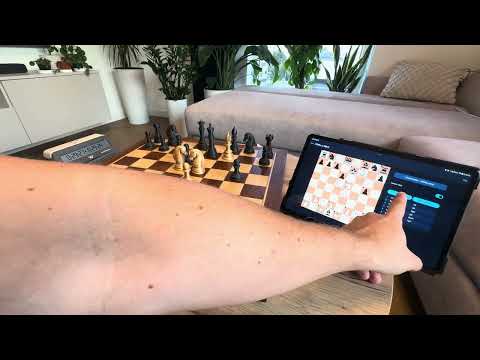
My friends and I play chess on a physical wooden board — and those games used to vanish the moment they ended: unrecorded, unreplayable, unanalyzable. Commercial smart boards solve that, but they are expensive and closed. So this one is built from scratch: a reed switch under every square, a magnet in every piece, and an ESP32 that streams what happens on the board over Bluetooth LE.
The board itself is deliberately dumb — it only reports raw piece lifts, placements and button presses. Everything smart happens in the app: a Kotlin Multiplatform client (one codebase for Android, iOS and web) resolves those raw sequences into moves, validates them against the full rules of chess (castling, en passant, promotions, pins, checks), and saves every accepted move as PGN — locally and to the cloud. Each side confirms its move with a button on a repurposed DGT chess clock, so the game keeps its physical rhythm; no touchscreen needed mid-play.
After the game, any device signed into the account can replay the record move by move and analyze every position with engine evaluations. Games played on the screen (pass-and-play) flow through exactly the same pipeline — the physical board is one input channel, not a special case.


- Google sign-in with a private, per-user game history (Supabase Auth + Postgres RLS).
- Digital pass-and-play on Android, iOS, and web — full legality validation (check, pins, castling, en passant, promotion), auto-detected checkmate/stalemate, crash-safe auto-save (local write-ahead journal + cloud backup).
- Physical-board play (Android + iOS) — piece lifts/places streamed over BLE are resolved into legal moves and confirmed with per-side chess-clock buttons; illegal or ambiguous sequences are rejected with a diagnostics-assisted recovery path, and an in-progress game survives app restarts and BLE drops.
- Live reed-switch diagnostics — per-square occupancy view of the real board.
- Replay & analysis — step through any saved game; position evaluations and best moves via Lichess Cloud Eval with a Stockfish fallback (Chess-API.com), cached server-side per position.
- History management — hard delete with confirmation; new accounts start with eight famous historical games pre-seeded.
┌──────────────┐  BLE GATT    ┌───────────────────────────┐  HTTPS    ┌─────────────────┐
│ ESP32 board  │─────────────>│ KMP app                   │──────────>│ Supabase Cloud  │
│ 8×8 reeds    │ lifts/places │ Android · iOS · Web(Wasm) │ REST/auth │ Postgres + RLS  │
│ 2 buttons    │ + confirms   │ rules engine · PGN · UI   │           │ Auth · Edge Fn  │
└──────────────┘              └───────────────────────────┘           └─────────────────┘
- The board is a dumb sensor — it reports raw square transitions and button presses only; the app derives the moves and enforces chess legality.
- PGN is the source of truth for every game; FEN is derived for replay/analysis.
- The backend is configuration, not code: Postgres schema + RLS + one Edge Function. Clients call Supabase directly — there is no bespoke server.
- The contract between the three parts (BLE protocol, API shapes, schema) lives in
docs/reference/contract-surfaces.md.
| Path | What it is |
|---|---|
SmartChessboard/ |
Kotlin Multiplatform app — Compose UI, chess rules engine, BLE client |
firmware/ |
ESP32 firmware — reed-matrix scan + BLE GATT peripheral |
supabase/ |
Backend as code — migrations, RLS, lichess-eval Edge Function |
context/ |
Product docs driving the workflow: PRD, firmware PRD, tech stack, roadmap, per-change plans |
docs/ |
Cross-cutting reference — most importantly contract-surfaces.md |
Each sub-project README covers its own setup, build, run, and test instructions.
The AGENTS.md files (root + one per sub-project) add rules for AI coding agents
and contributors.
All MVP roadmap slices are implemented and verified on real hardware, including physical play over BLE. See the roadmap for per-slice status and what remains (BLE connectivity hardening).
Copyright © 2026 Rafał Urbaniak.
The source code in this repository is licensed under the Apache License 2.0 — you may use, modify, and distribute it (including commercially) provided you retain the copyright and license notices and state any changes you make, per the license terms. It is provided "as is", without warranty.
Exception — chess-piece artwork: the 12 chess-piece vector drawables
(SmartChessboard/shared/src/commonMain/composeResources/drawable/piece_*.xml) are
derived from Colin M.L. Burnett's SVG set and remain under
CC BY-SA 3.0 — not Apache-2.0.
See docs/attributions.md for full attribution and terms.