A federated Digital Twin framework for sovereign territorial data governance.
Author: Josue Mendes · Diplom-Architekt (USB/Anabin H+) · BIM Specialist
Contact: josuemendesv@gmail.com
License: AGPL-3.0
Status: Proof of Concept + Executive Summary (v0.2.0)
SILVIA is a modular framework that converts qualitative territorial observations into structured ecological knowledge graphs. It bridges the gap between ISO 19650 digital twin standards and low-connectivity environments where communities monitor their own territories.
A community member sends a WhatsApp message describing what they observe. SILVIA identifies the community context, interprets the observation using a locally-defined knowledge base, calculates a Territorial Regeneration Index (TRI), and stores everything as linked notes in an Obsidian vault — creating a visual Digital Twin that grows with every observation.
Theoretical Foundation:
The primitive hut — Laugier's 1753 argument that legitimate architecture emerges from the inhabitant's own needs, built with available means, without external imposition — is not a building. It is an argument about who has the right to build.
SILVIA applies the same argument to data.
The community that inhabits a territory is the only legitimate author of its digital twin. External observers — researchers, NGOs, state agencies — can contribute observations, but those observations carry less epistemic weight than the knowledge accumulated by the people who live, cultivate, and mourn within that territory. This is not a political position. It is a methodological one: data generated without sovereignty is structurally incomplete.
This is why IIS (Indigenous/Inhabitant Information Sovereignty) is not a correction factor in the TRI — it is the index's epistemological spine. The same observation generates a different score depending on who reports it, because the same observation means something different depending on who holds the knowledge that contextualizes it.
SILVIA began as a promise made in Kanaimö, Gran Sabana, Venezuela — where a community asked not for aid, but for professionals. The primitive hut they needed was not architectural. It was epistemic: a system to make their knowledge durable, queryable, and sovereign.
Proof of Concept is available on youtube:
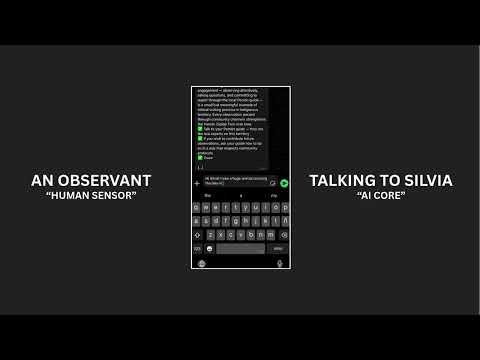
SILVIA's current development stage focuses on IFC integration, enabling structured observation data to be exported as semantically rich files compatible with openBIM workflows. This bridges community territorial knowledge with ISO 19650 digital twin standards at the building and territory scale.
Three-layer stack:
Layer 1 — SILVIA Core: Community detection, universal TRI calculation, CARE data sovereignty principles, response formatting. Territory-agnostic.
Layer 2 — Community Modules: Pluggable knowledge bases per territory. Each module defines local species indicators, toponymy, seasonal patterns, and cultural practices. Currently implemented: Pemón/Kanaimö (Gran Sabana, Venezuela) and Caracas Urban.
Layer 3 — DT Lifecycle: Analytical capacity scales with data maturity. Shadow (no data) → Embryonic (<50 observations) → Juvenile (50-500) → Mature (500+, community-validated).
Composite metric grounded in Berkes (2008), Mang & Reed (2012), and Niemi & McDonald (2004):
TRI = (w1 × ESD) + (w2 × TCI) + (w3 × RAR_norm) + (w4 × IIS)
| Variable | Range | Description |
|---|---|---|
| ESD | 0–1 | Ecosystem Services Diversity |
| TCI | 0–1 | Territorial Cultural Integrity |
| RAR | -1 to 1 | Regeneration-to-Alteration Ratio |
| IIS | 0–1 | Indigenous/Inhabitant Information Sovereignty |
Default weights: ESD=0.25, TCI=0.25, RAR=0.30, IIS=0.20. Overridable per community module. These are working hypotheses pending empirical validation.
The differentiator from conventional indices: IIS quantifies data sovereignty. The same observation generates a different TRI depending on whether it comes from a community leader (IIS=1.0) or an external observer (IIS=0.3).
- Interface: WhatsApp (Twilio + Cloudflare Tunnel)
- Backend: Flask / Python 3.10+
- Inference: Claude API (Anthropic), structured JSON output
- Index: TRI engine with per-module weight configuration
- Storage: Obsidian vault with wikilinked markdown notes
- Governance: CARE principles as flags in every observation
SILVIA/
├── app.py                    # Flask + Twilio webhook
├── silvia_agent.py           # Core agent, dynamic prompt composition
├── tri_engine.py             # TRI calculator
├── obsidian_vault.py         # Obsidian note generator
├── test_integration.py       # Integration tests (no API key needed)
├── prompts/
│   └── silvia_core.txt       # System prompt (Layer 1)
└── community_modules/
    ├── pemon_kanaimo.txt     # Pemón territory module
    └── caracas_urban.txt     # Caracas urban module
python3 -m venv venv && source venv/bin/activate
pip install -r requirements.txt
cp .env.example .env  # add your keys

python tri_engine.py           # unit tests
python test_integration.py     # full pipeline test (no API key)
python app.py # start serverSILVIA addresses the gap identified by Petzold (2024) in "Situating Digital Participation" — the disconnect between digital twin infrastructure and the communities inhabiting modeled territories. The Obsidian knowledge graph is visual proof of the DT lifecycle: empty vault = Shadow, clustered nodes = Embryonic, dense network = Mature.
- Berkes, F. (2008). Sacred Ecology. Routledge.
- Mang, P., & Reed, B. (2012). Designing from place. Building Research & Information, 40(1), 23-38.
- Niemi, G. J., & McDonald, M. E. (2004). Application of ecological indicators. AREES, 35, 89-111.
- Petzold, F. (2024). Situating Digital Participation. TUM.
- CARE Principles for Indigenous Data Governance. GIDA.
AGPL-3.0 — derivative works must remain open source, protecting the framework as a tool for community sovereignty.
@software{mendes_silvia_2026,
  author       = {Mendes, Josue},
  title        = {{SILVIA: Sovereign Information Learning Virtual Intelligent Architecture}},
  year         = 2026,
  publisher    = {Zenodo},
  version      = {v0.2.0},
  doi          = {10.5281/zenodo.19616669}
}
Developed in Munich, Germany. Research origins: Gran Sabana, Venezuela (2022-2023).