








KodeAgent is a frameworkless, minimalistic approach to building AI agents. Written in ~3 KLOC (~2.2K statements) of pure Python, KodeAgent is designed to be the robust reasoning core inside your larger system, not the entire platform.
KodeAgent adheres to the Unix Philosophy: do one thing well and integrate seamlessly.
Use KodeAgent because it offers:
- ReAct & CodeAct: KodeAgent supports both ReAct and CodeAct agent paradigms out-of-the-box, enabling agents to reason and act using tools or by generating and executing code.
- Guidance and Auto-Correction: Includes a "Planner" to plan the steps and an internal "Observer" to monitor progress, detect loops or stalled plans, and provide corrective feedback to stay on track.
- Scalable: With only a few dependencies, KodeAgent perfectly integrates into serverless environments, standalone applications, or existing platforms.
- LLM Agnostic: Built on LiteLLM, KodeAgent easily swaps between models (e.g., Gemini, OpenAI, and Claude) without changing your core logic.
- Lightweight Glass Box: Read the entire source and debug without fighting opaque abstraction layers. Follow the key abstractions and build something on your own!
Also, here are a few reasons why you shouldn't use KodeAgent:
- KodeAgent is actively evolving, meaning some aspects may change.
- You want to use some of the well-known frameworks.
- You need a full-fledged platform with built-in long-term, persistent memory management.

Install KodeAgent via pip:
pip install -U kodeagent # Upgrade existing installationOr if you want to clone the KodeAgent GitHub repository locally and run from there, use:
git clone https://github.com/barun-saha/kodeagent.git

python -m venv venv
source venv/bin/activate
# venv\Scripts\activate.bat  # Windows

pip install -r requirements.txt
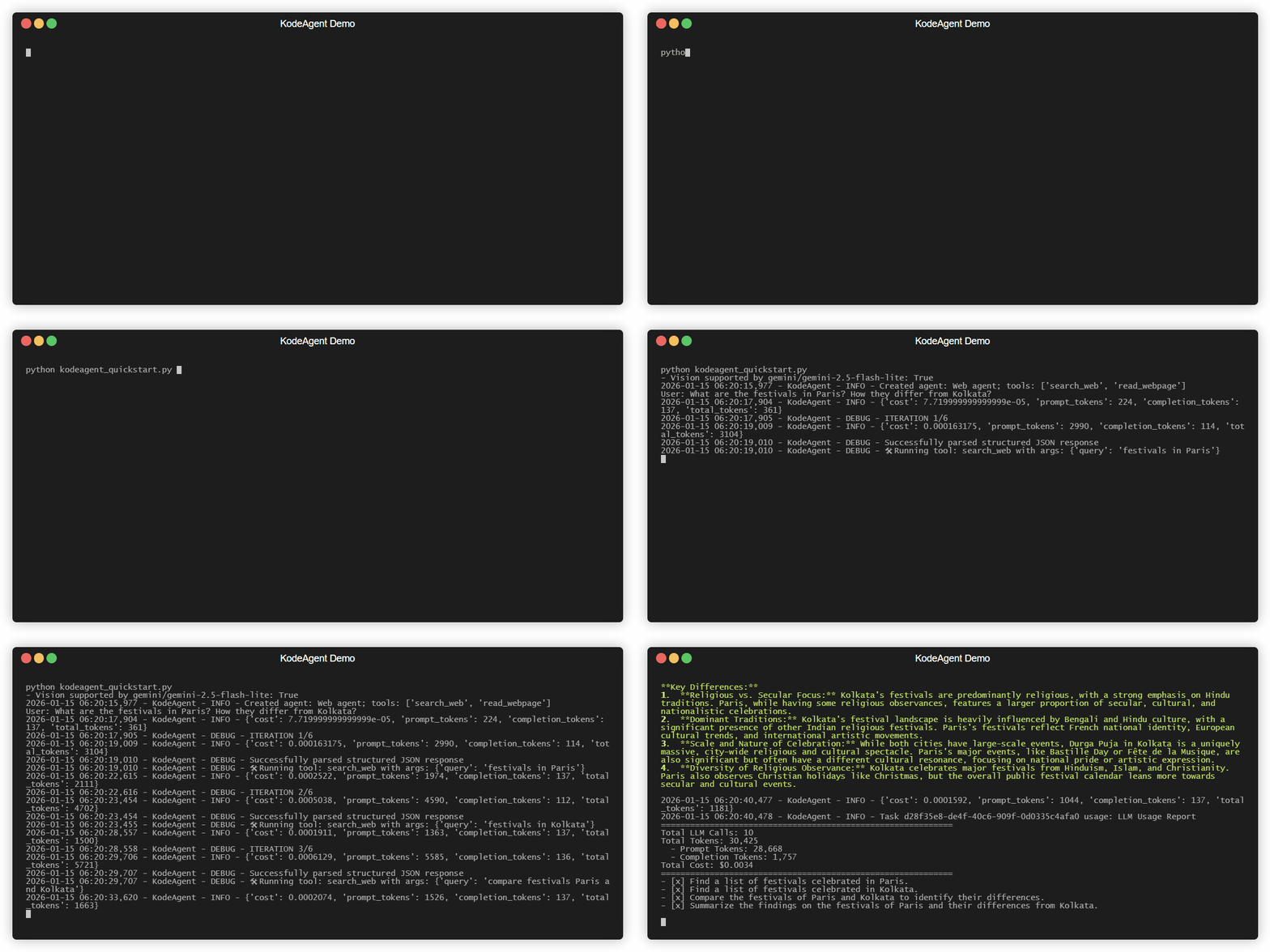
Now, in your application code, create a ReAct agent and run a task like this (see examples/_quickstart/kodeagent_quickstart.py):
from kodeagent import ReActAgent, print_response
from kodeagent.tools import read_webpage, search_web

agent = ReActAgent(
    name='Web agent',
    model_name='gemini/gemini-2.5-flash-lite',
    tools=[search_web, read_webpage],
    max_iterations=5,
)

for task in [
    'What are the festivals in Paris? How they differ from Kolkata?',
]:
    print(f'User: {task}')

    async for response in agent.run(task):
        print_response(response, only_final=True)
You can also create a CodeActAgent, which leverages the core CodeAct pattern to generate and execute Python code on the fly for complex tasks. For example:
from kodeagent import CodeActAgent
from kodeagent.tools import read_webpage, search_web, extract_as_markdown

agent = CodeActAgent(
    name='Web agent',
    model_name='gemini/gemini-2.0-flash-lite',
    tools=[search_web, read_webpage, extract_as_markdown],
    run_env='host',
    max_iterations=7,
    allowed_imports=[
        're', 'requests', 'ddgs', 'urllib', 'requests', 'bs4',
        'pathlib', 'urllib.parse', 'markitdown'
    ],
    pip_packages='ddgs~=9.5.2;beautifulsoup4~=4.14.2;"markitdown[all]";',
)
That's it! Your agent should start solving the task and keep streaming the updates.
By default, an agent is memoryless across tasks—each task begins with no prior context, a clean slate. To enable context from the previous task (only), use Recurrent Mode:
# Enable recurrent mode to leverage context from the previous run
async for response in agent.run('Double the previous result', recurrent_mode=True):
    print_response(response)
For more examples, including how to provide files as inputs, see the kodeagent.py module and API documentation.
KodeAgent uses LiteLLM for model access and Langfuse or LangSmith for observability. Set your API keys as environment variables or in a .env file:
| Service | Environment Variable |
|---|---|
| Gemini | GOOGLE_API_KEY |
| OpenAI | OPENAI_API_KEY |
| Anthropic | ANTHROPIC_API_KEY |
| E2B Sandbox | E2B_API_KEY |
| Langfuse | LANGFUSE_PUBLIC_KEY, LANGFUSE_SECRET_KEY |
| LangSmith | LANGCHAIN_API_KEY, LANGCHAIN_TRACING_V2 |
Detailed configuration for various providers can be found in the LiteLLM documentation.
CodeActAgent executes LLM-generated code to leverage the tools. KodeAgent currently supports two different code run environments:
host: The Python code will be run on the system where you created this agent. In other words, where the application is running.e2b: The Python code will be run on an E2B sandbox. You will need to set theE2B_API_KEYenvironment variable.
With host as the code running environment, no special steps are required, since it uses the current Python installation. However, with e2b, code (and tools) are copied to a different environment and are executed there. Therefore, some additional setup may be required.
You can also specify a work_dir to serve as a local workspace. For the e2b environment, any files generated by the agent in the sandbox will be automatically downloaded to this local work_dir. If specified, work_dir could be relative or absolute path, but it must exist; otherwise, a temporary directory will be created and used for each run.
from kodeagent import CodeActAgent

agent = CodeActAgent(
    name='Data Agent',
    model_name='gemini/gemini-2.0-flash-lite',
    run_env='e2b',
    work_dir='/home/user/agent_workspace',  # Local workspace directory to copy files to/from E2B
    # ... other parameters
)
For example, the Python modules that are allowed to be used in code should be explicitly specified using allowed_imports. In addition, any additional Python package that may need to be installed should be specified as a comma-separated list via pip_packages.
KodeAgent is under active development. Capabilities are limited. Use with caution.
KodeAgent comes with the following built-in tools:
calculator: A simple calculator tool to perform basic arithmetic operations. It imports theast,operator, andrePython libraries.download_file: A tool to download a file from a given URL. It imports therequests,re,tempfile,pathlib, andurllib.parsePython libraries.extract_as_markdown: A tool to read file contents and return as Markdown using MarkItDown. It imports there,pathlib,urllib.parse, andmarkitdownPython libraries.generate_image: A tool to generate an image based on a text prompt using the specified model. The (LiteLLM) model name to be used must be mentioned in the task, system prompt, or somehow. It imports theos,base64, andlitellmPython libraries.read_webpage: A tool to read a webpage using BeautifulSoup. It imports there,requests,urllib.parse, andbs4Python libraries.search_arxiv: A tool to search arXiv for research papers and return summaries and links. It imports thearxivlibrary.search_web: A web search tool using DuckDuckGo to fetch top search results. It imports thedatetime,random, andtimePython libraries.search_wikipedia: A tool to search Wikipedia and return summaries and links. It imports thewikipedialibrary.transcribe_audio: A tool to transcribe audio files using OpenAI's Whisper via Fireworks API. Need to set theFIREWORKS_API_KEYenvironment variable. It imports theosandrequestsPython libraries.transcribe_youtube: A tool to fetch YouTube video transcripts. It imports theyoutube_transcript_apilibrary.
Check out the docstrings of these tools in the tools.py module for more details.
To add a new tool, use the @tool decorator from kodeagent.tools module. For example:
from kodeagent import tool

@tool
def my_tool(param1: str) -> str:
    """Description of the tool.
    Args:
        param1 (str): Description of param1.
    Returns:
        str: Description of the return value.
    """
    # Tool implementation here
    return 'result'
Module imports and all variables should be inside the tool function. If you're using CodeActAgent, KodeAgent will execute the tool function in isolation.
For further details, refer to the API documentation. Note: async tools are not supported.
In addition to the logs, KodeAgent enables agent observability via third-party solutions, such as Langfuse and LangSmith.
To enable tracing, set the relevant environment variables (e.g., LANGFUSE_PUBLIC_KEY and LANGFUSE_SECRET_KEY for Langfuse, or LANGCHAIN_API_KEY and LANGCHAIN_TRACING_V2='true' for LangSmith). Note that langsmith is not installed by default with KodeAgent and must be installed separately with pip install langsmith. Then, in the code, specify tracing_type as langfuse or langsmith when creating the agent:
from kodeagent import ReActAgent

agent = ReActAgent(
    name='Web agent',
    model_name='gemini/gemini-2.5-flash-lite',
    tools=[search_web, read_webpage],
    tracing_type='langfuse',  # or 'langsmith'
)
Tracing is disbled by default (rather, a no-op tracer is used). You will need to explicitly enable it, as shown in the code snippet above. The screenshot below shows a sample trace of KodeAgent running a task on the Langfuse dashboard:

sequenceDiagram
  autonumber
  actor User
  participant Agent
  participant Planner
  participant LLM as LLM/Prompts
  participant Tools

  User->>Agent: run(task)
  Agent->>Planner: create_plan(task)
  Planner->>LLM: request AgentPlan JSON (agent_plan.txt)
  LLM-->>Planner: AgentPlan JSON
  Planner-->>Agent: planner.plan set

  loop For each step
    Agent->>Planner: get_formatted_plan()
    Agent->>LLM: codeact prompt + {plan, history}
    LLM-->>Agent: Thought + Code
    Agent->>Tools: execute tool call(s)
    Tools-->>Agent: Observation
    Agent->>Planner: update_plan(thought, observation, task_id)
  end

  Agent-->>User: Final Answer / Failure (per codeact spec)
To run unit tests, use:
python -m pytest .\tests\unit -v --cov --cov-report=htmlFor integration tests involving calls to APIs, use:
python -m pytest .\tests\integration -v --cov --cov-report=htmlGemini and E2B API keys should be set in the .env file for integration tests to work.
A Kaggle notebook for benchmarking KodeAgent is also available.
The following results were measured using Scalene and psutil on development machine (Windows 10, Python 3.10). "Peak Memory" refers to the maximum Resident Set Size (RSS), i.e., the actual RAM used by the process.
python -m scalene run -c scalene.yaml -m src.kodeagent.kodeagent
scalene view| Agent Type | Avg. Runtime | Peak Memory (Scalene) | Peak Memory (psutil) | Notes |
|---|---|---|---|---|
| ReActAgent | ~58s | 21MB | 294MB | Faster, because tools are directly executed |
| CodeActAgent | ~155s | 21MB | 253MB | Slower, because of code review and execution |
Notes:
- Scalene reports the maximum sampled RSS during profiling, which is useful for comparing code sections but may miss short-lived or end-of-program memory spikes.
- psutil reports the actual RSS at program end, which is typically higher and reflects the real-world memory footprint.
- Actual memory usage may vary depending on your system, Python version, and workload.
To be updated.
KodeAgent heavily borrows code and ideas from different places, such as:
- LlamaIndex
- Smolagents
- LangGraph
- Building ReAct Agents from Scratch: A Hands-On Guide using Gemini
- LangGraph Tutorial: Build Your Own AI Coding Agent
- Aider, Antigravity, CodeRabbit, GitHub Copilot, Jules, ...
AI agents can occasionally cause unintended or unpredictable side effects. We urge users to use KodeAgent with caution. Always review generated code and test agents rigorously in a constrained, non-production environment before deployment.
LIMITATION OF LIABILITY: By using this software, you agree that KodeAgent, its developers, contributors, supporters, and any other associated entities shall not be liable for any direct, indirect, incidental, special, exemplary, or consequential damages (including, but not limited to, procurement of substitute goods or services; loss of use, data, or profits; or business interruption) however caused and on any theory of liability, whether in contract, strict liability, or tort (including negligence or otherwise) arising in any way out of the use of this software.