
In research and education, computers and internet have been widely adopted. There is many formats, online service and software packages that can be used for learning of molecules and atoms in dynamics simulation. The basic format consists of:
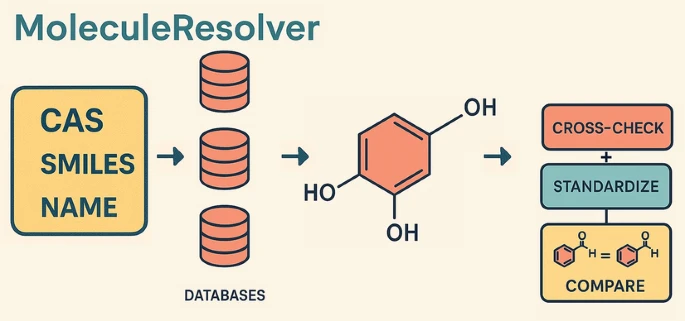
DOI: https://doi.org/10.1186/s13321-025-01064-7
- SMILES
Simplified Molecular-Input Line-Entry System - SMART
Smiles Arbitary Target Specification - XYZ
XYZ-py - Molfile
MDL Molfile - Chemical Markup Language format based on Extensible Markup Language
XML-based formats - InChI and InChIkey
The international Chemical Identifier
There are several free online service and database that can be searched for information about chemical compounds.
- Wikipedia
wikipedia.org - Chemspider by the Royal Society Chemistry
www.chemspider.com - PubChem by National Intitute of Health (NIH)
https://pubchem.ncbi.nlm.nih.gov - NIST (The US National Institute of Standards and Technology)
https://webbook.nist.gov/chemistry/
ChemSpiPy is a Python library that interact with the ChemSpider API. It allow chemical searches, chemical file download by querying the ChemSpider service over the internet automatically import data without having to visit the ChemSpider website.
Deduces the srtucture of the following molecules from their InChi strings:
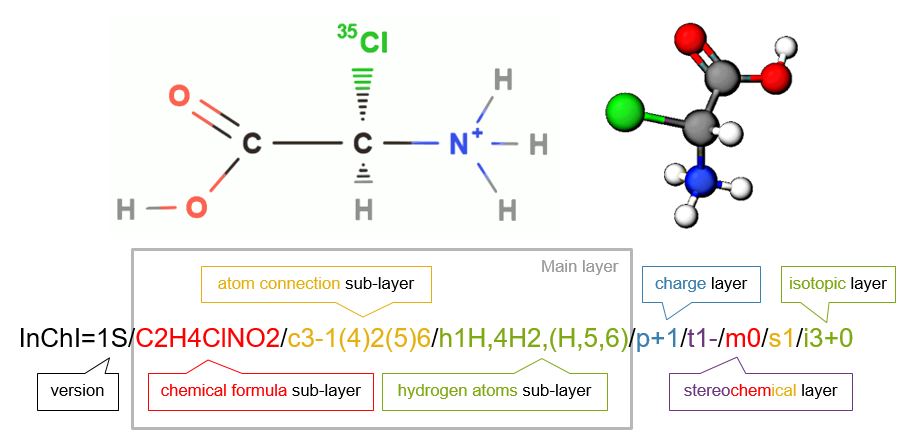
Reference: Line Notation SMILES and InChI
- InChI=1S/C6H60/c7-6-4-2-1-3-5-6/h1-5,7H
- InChI=1S/C5H12O/c1-3-5(2)4-6/h5-6H,3-4H2,1-2H3
- InChI=1S/C6H10/c1-6-4-2-3-5-6/h4H,2-3, 5H2,1H3
- InChI=1S/C5H9NO2/c7-5(8)4-2-1-3-6-4/h4,6H,1-3H2,(H,7,8)
Hint: the notation (H,7,8) means that a single hydrogen atom is shared by atoms 7 and 8.
from chemspipy import ChemSpider
cs = ChemSpider('YOUR_API-KEY')

# Search by InChI string
c = cs.get_compound(971)

# Print basic info
print('1 Common Name:', c.common_name)
print('ChemSpider ID:', c.csid)
print('Molecular Formula:', c.molecular_formula)
print('Molecular Weight:', c.molecular_weight)
print('InChI:', c.inchi)
print('InChI Key:', c.inchikey)
print('SMILES:', c.smiles)
1 Common Name: Phenol
ChemSpider ID: 971
Molecular Formula: C_{6}H_{6}O
Molecular Weight: 94.113
InChI: InChI=1S/C6H6O/c7-6-4-2-1-3-5-6/h1-5,7H
InChI Key: ISWSIDIOOBJBQZ-UHFFFAOYSA-N
SMILES: Oc1ccccc1
from chemspipy import ChemSpider
cs = ChemSpider('YOUR_API-KEY')

# Search by InChI string
c = cs.get_compound(8398)

# Print basic info
print('2 Common Name:', c.common_name)
print('ChemSpider ID:', c.csid)
print('Molecular Formula:', c.molecular_formula)
print('Molecular Weight:', c.molecular_weight)
print('InChI:', c.inchi)
print('InChI Key:', c.inchikey)
print('SMILES:', c.smiles)
2 Common Name: 2-Methylbutan-1-ol
ChemSpider ID: 8398
Molecular Formula: C_{5}H_{12}O
Molecular Weight: 88.15
InChI: InChI=1S/C5H12O/c1-3-5(2)4-6/h5-6H,3-4H2,1-2H3
InChI Key: QPRQEDXDYOZYLA-UHFFFAOYSA-N
SMILES: CCC(C)CO
from chemspipy import ChemSpider
cs = ChemSpider('YOUR_API-KEY')

# Search by InChI string
c = cs.get_compound(12222)

# Print basic info
print('3 Common Name:', c.common_name)
print('ChemSpider ID:', c.csid)
print('Molecular Formula:', c.molecular_formula)
print('Molecular Weight:', c.molecular_weight)
print('InChI:', c.inchi)
print('InChI Key:', c.inchikey)
print('SMILES:', c.smiles)
3 Common Name: Methylcyclopentene
ChemSpider ID: 12222
Molecular Formula: C_{6}H_{10}
Molecular Weight: 82.146
InChI: InChI=1S/C6H10/c1-6-4-2-3-5-6/h4H,2-3,5H2,1H3
InChI Key: ATQUFXWBVZUTKO-UHFFFAOYSA-N
SMILES: CC1=CCCC1
from chemspipy import ChemSpider
cs = ChemSpider('YOUR_API-KEY')

# Search by InChI string
c = cs.get_compound(128566)

# Print basic info
print('4 Common Name:', c.common_name)
print('ChemSpider ID:', c.csid)
print('Molecular Formula:', c.molecular_formula)
print('Molecular Weight:', c.molecular_weight)
print('InChI:', c.inchi)
print('InChI Key:', c.inchikey)
print('SMILES:', c.smiles)
4 Common Name: L-Proline
ChemSpider ID: 128566
Molecular Formula: C_{5}H_{9}NO_{2}
Molecular Weight: 115.132
InChI: InChI=1S/C5H9NO2/c7-5(8)4-2-1-3-6-4/h4,6H,1-3H2,(H,7,8)/t4-/m0/s1
InChI Key: ONIBWKKTOPOVIA-BYPYZUCNSA-N
SMILES: O=C(O)[C@@H]1CCCN1
The simplified Molecular-Input Line-Entry System (SMILES) represents chemical species as short, plain text (ASCII) strings. This SMILES specification is divided into two distinct parts: A syntactic specification specifies how the atoms, bonds, parentheses, digits, and so forth are represented, and a Semantic SPecification that describes how those symbols are interpreted as a sensible molecule.
The function and arguments:
read_smilesexplicit_hydrogen = Falsezero_order_bonds = Truereinterpret_aromatic = Truestrict = True
Write the SMILES strings for the following molecules:
-
Toulena, Ph-CH3
-
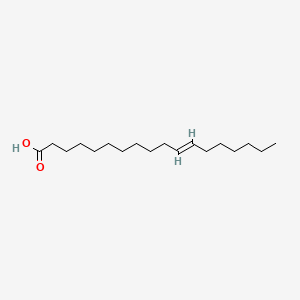
The trans fatty acid, vaccenic acid:
-
Glycine, H2NCH2COOH
-
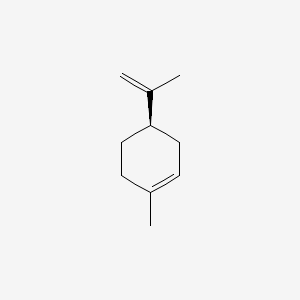
D-Limonene:
-
Hydrindane (bycylo[4.3.0]nonane):
from chemspipy import ChemSpider
cs = ChemSpider('YOUR_API-KEY')

# Search by InChI string from ChemSpider ID
c = cs.get_compound(1108)
print('SMILES Toluena:', c.smiles)

c = cs.get_compound(4445888)
print('SMILES Vaccenic Acid:', c.smiles)

c = cs.get_compound(730)
print('SMILES Glycine,:', c.smiles)

c = cs.get_compound(2591)
print('SMILES D-Limonene,:', c.smiles)

C = cs.get_compound(10459)
print('SMILES bycylo[4.3.0]nonane,:', c.smiles)
SMILES Toluena: Cc1ccccc1
SMILES Vaccenic Acid: CCCCCC/C=C\CCCCCCCCCC(=O)O
SMILES Glycine,: NCC(=O)O
SMILES D-Limonene,: OCC1OC(n2cnc3c(NC4CCCCC4)ncnc32)C(O)C1O
SMILES bycylo[4.3.0]nonane,: OCC1OC(n2cnc3c(NC4CCCCC4)ncnc32)C(O)C1O