Skip to content

OUROBOROS is a forensic toolkit for binary analysis that fuses mathematical, statistical, and interdisciplinary signals into explainable ensemble verdicts for malware and anomaly detection.

License

Notifications You must be signed in to change notification settings

la-b-ib/OUROBOROS

OUROBOROS

OUROBOROS is a research-focused forensic toolkit that analyzes binary executables using a broad set of mathematical, statistical and interdisciplinary methods. It is designed to extract robust, explainable signals (topological, spectral, dynamical, informational) and fuse them into an ensemble verdict for advanced malware and anomaly detection.

Details

Project Details

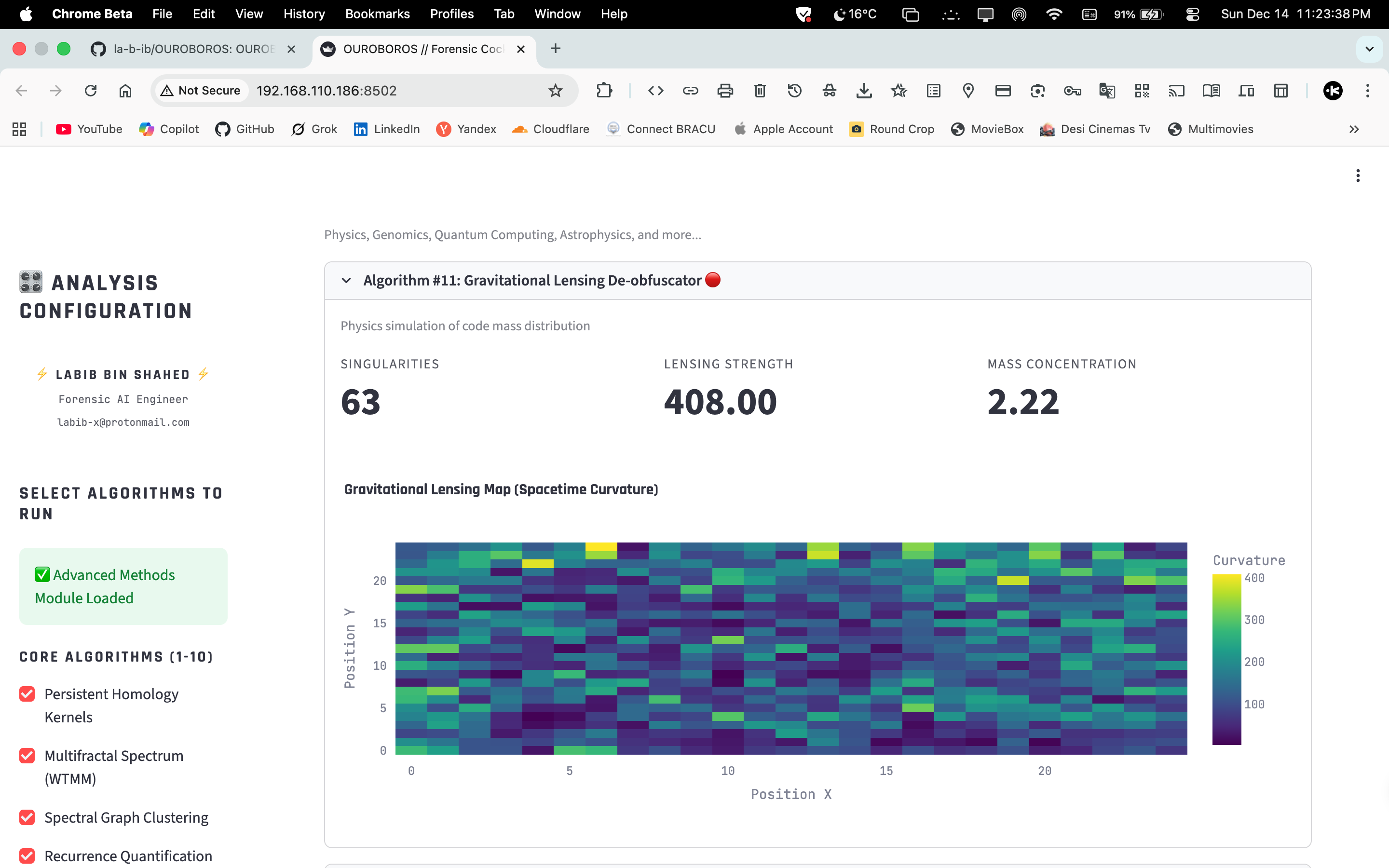
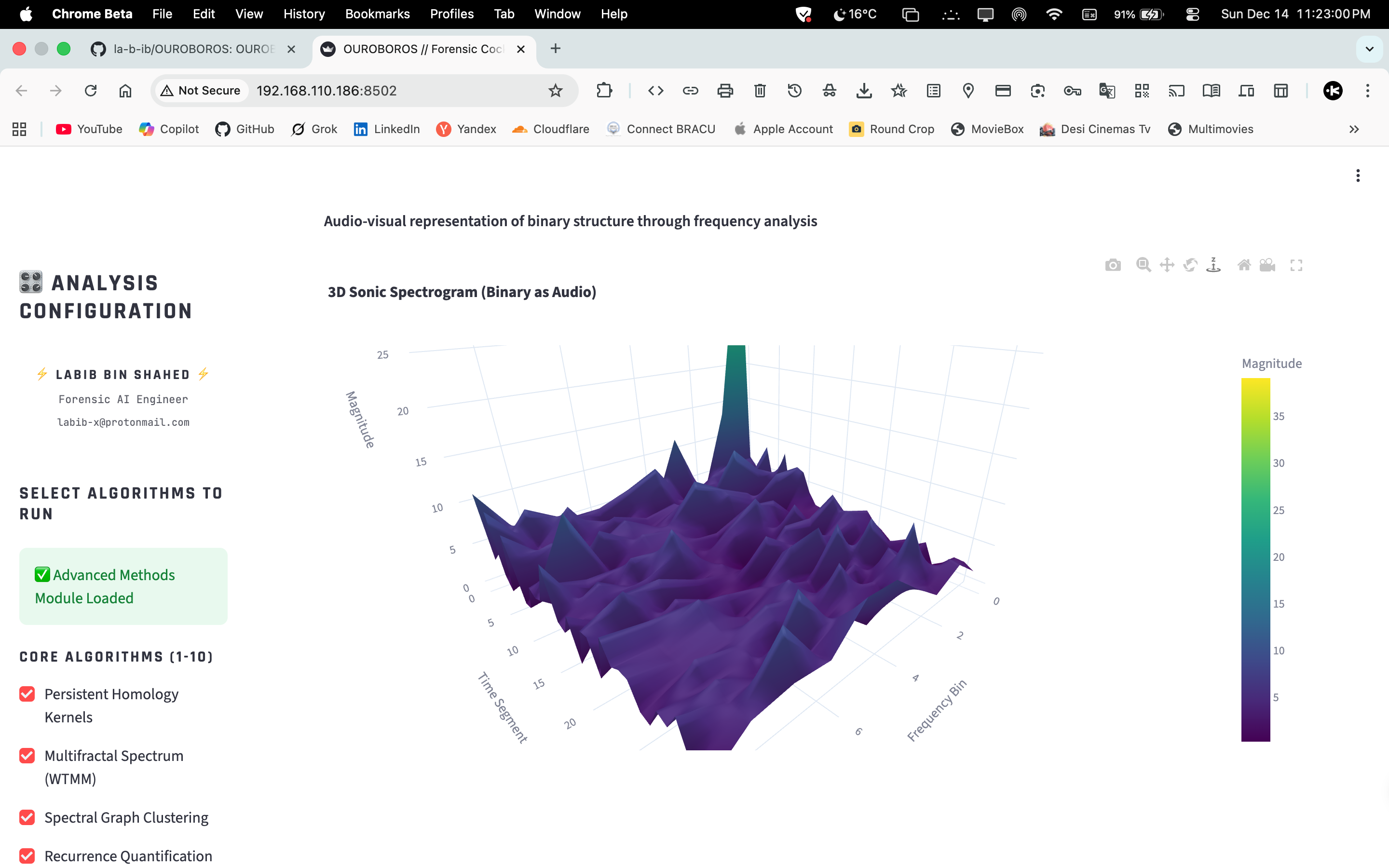
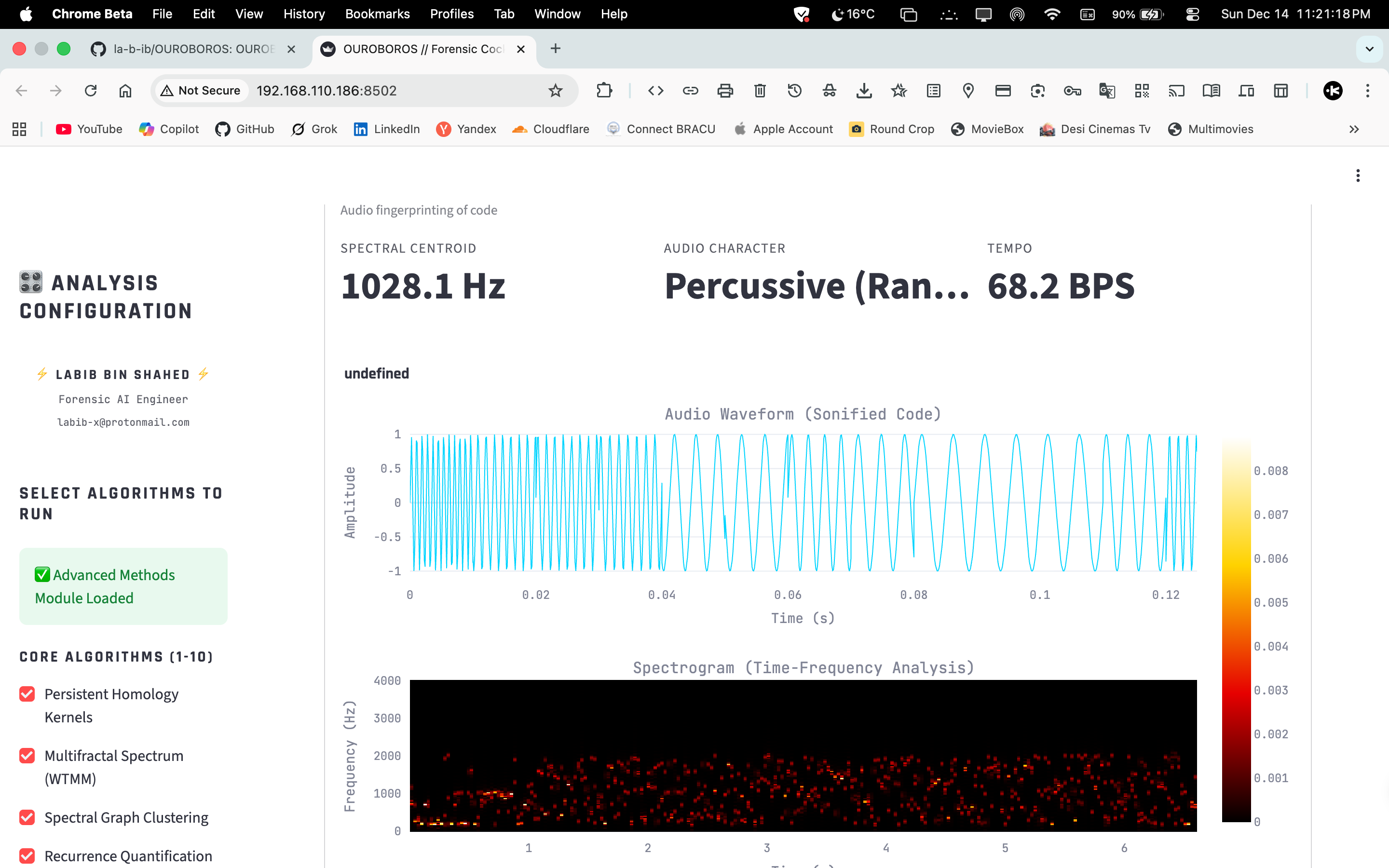
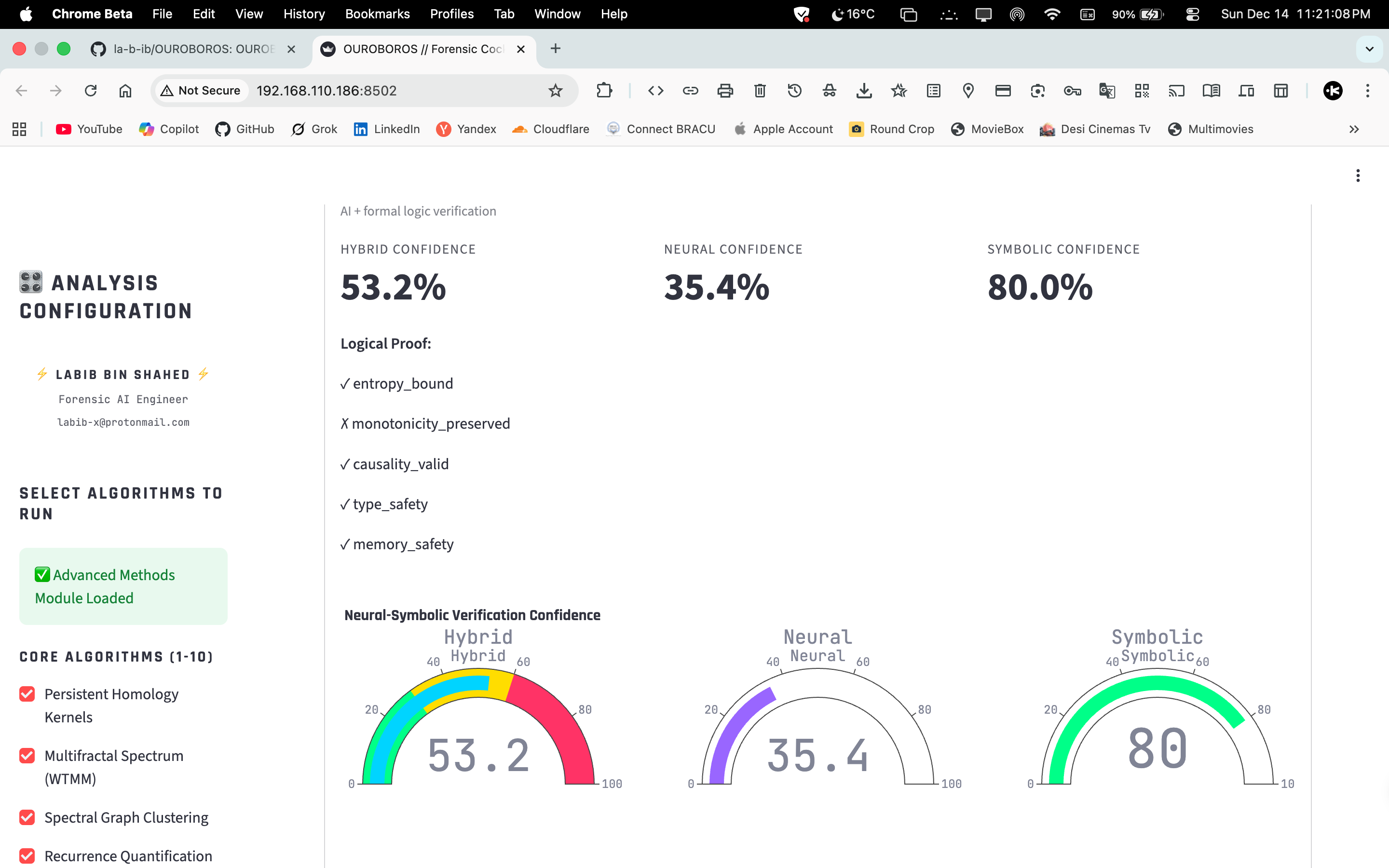
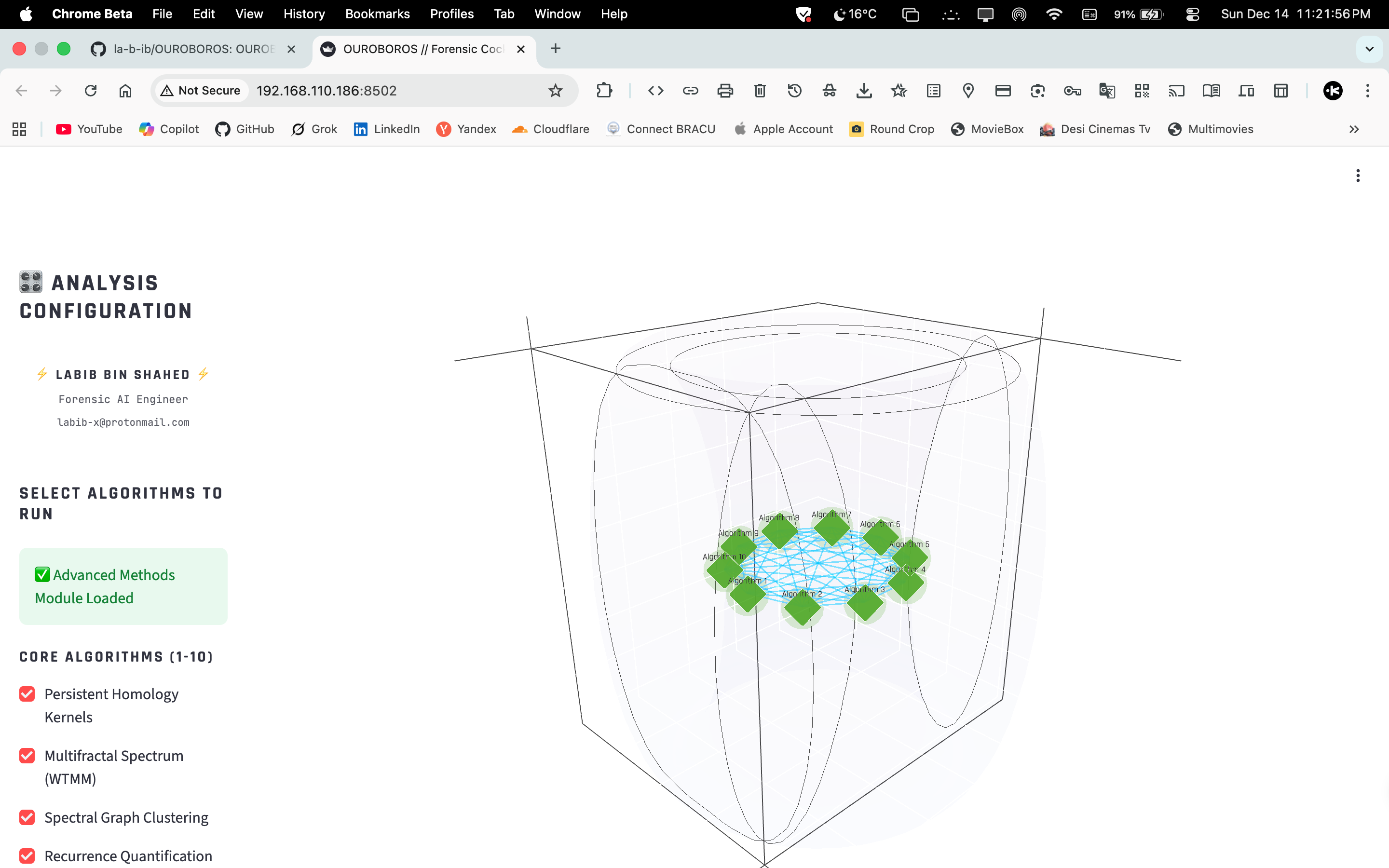
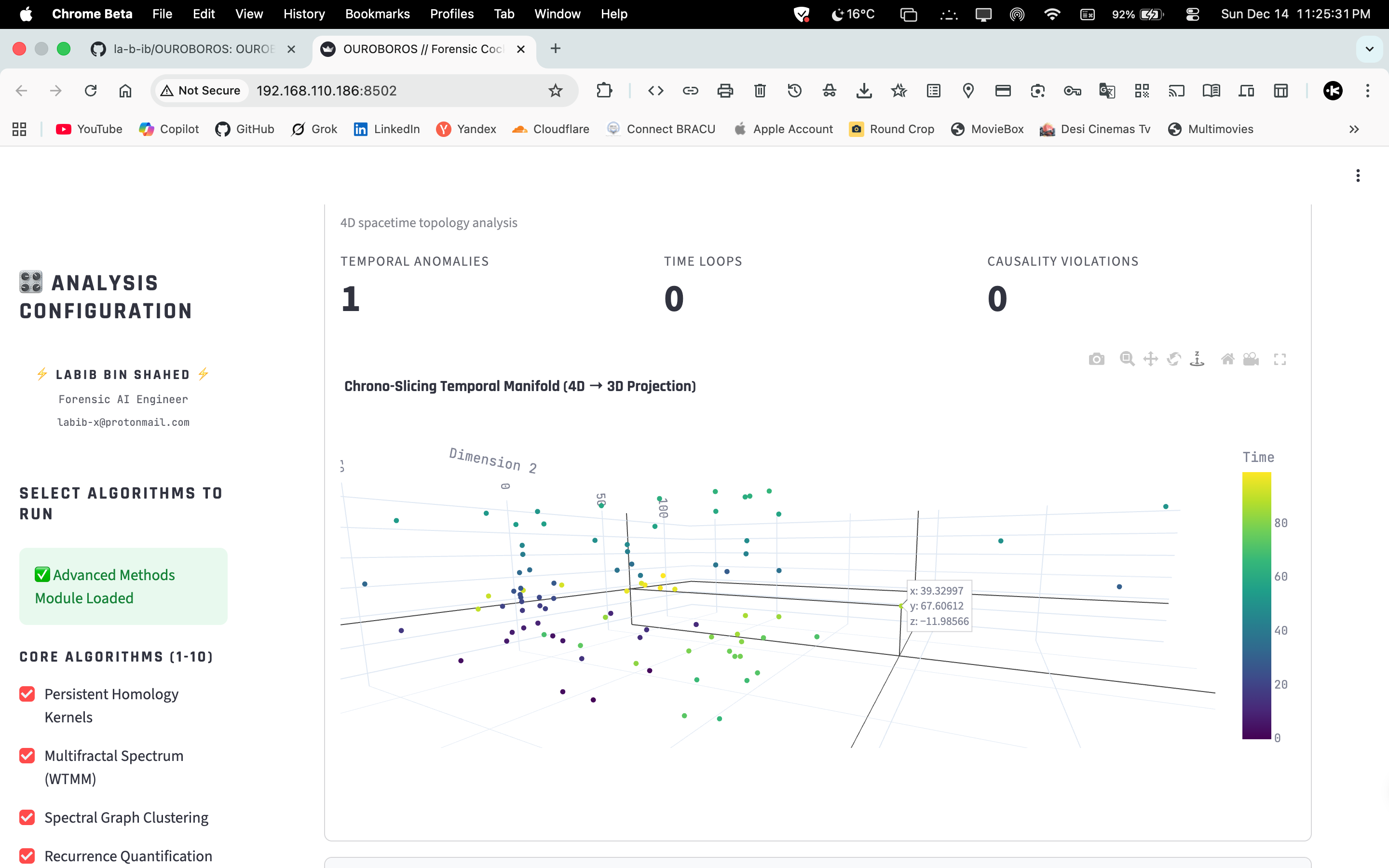
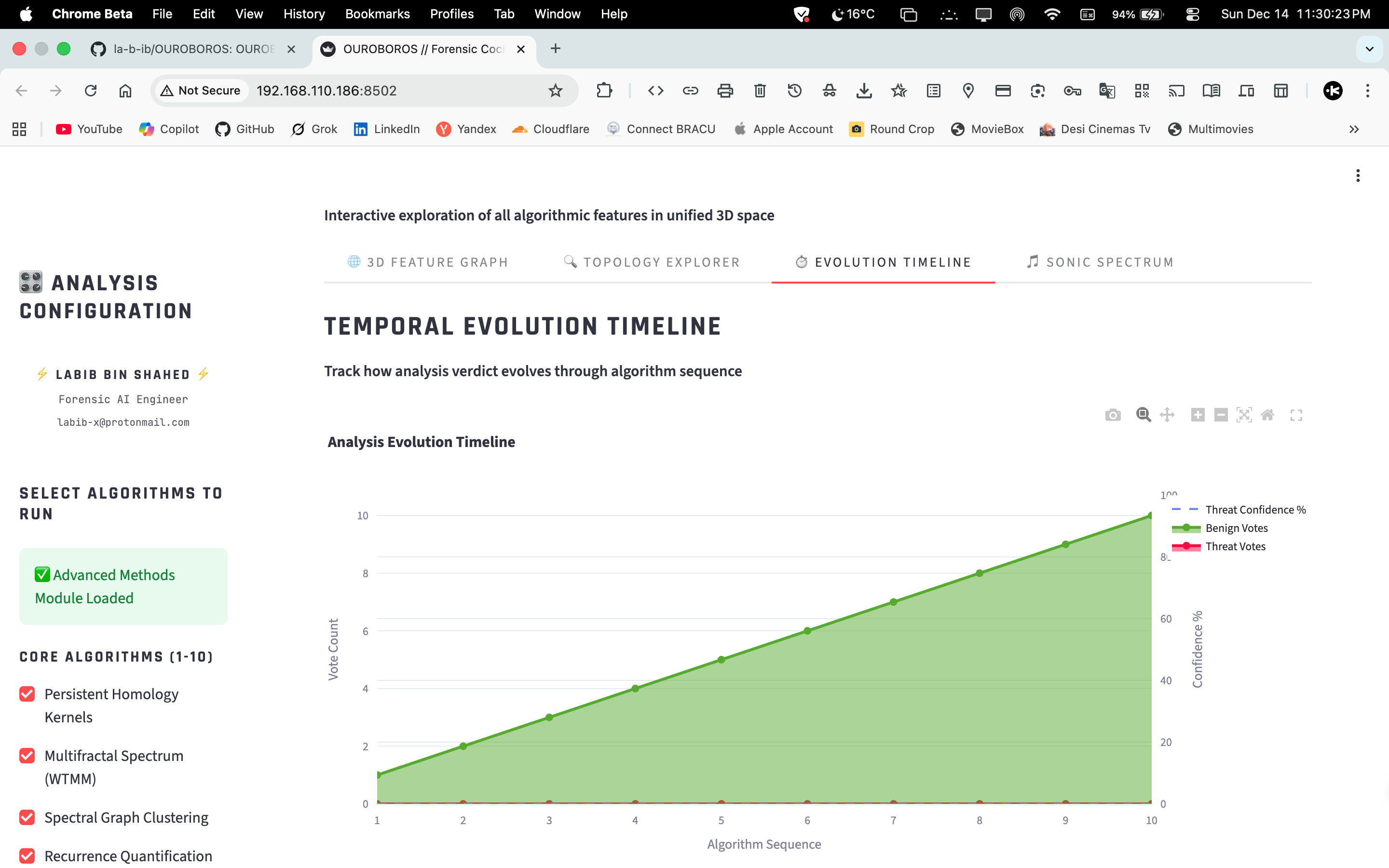
OUROBOROS Preview

Technical Details

Algorithms

  • Topology & Fractals — homology, zigzag, autoencoder, multifractal, fluid TDA.
  • Graphs & Dynamics — spectral clustering, DTW, quantum walk, symbiotic trees, chrono‑slicing.
  • Entropy & Compression — NCD, event horizons, Benford, stylometry.
  • Symbolic & Hybrid — Z3 execution, neural‑symbolic verifier, gravitational lensing.
  • Latent & Perceptual — LDA topics, MinHash LSH, RQA, sonification.

Mathematical Appendix

1. Takens' Embedding Theorem, VR Persistence Stability, Wasserstein Kernels & Persistent Entropy

For dynamical system $f: M \to M$, observation $\phi: M \to \mathbb{R}$, define delay map: $$F(x) = (\phi(x), \phi(f(x)), \dots, \phi(f^{2m}(x)))$$ where $m = \dim(M)$. Generically, $F$ is embedding. Implementation: $d \geq 2m+1$, $\tau$ optimal: $$\text{MI}(\tau) = \sum p(x_t, x_{t+\tau}) \log\frac{p(x_t, x_{t+\tau})}{p(x_t)p(x_{t+\tau})}$$ Vectors: $X_i = [x_i, x_{i+\tau}, \dots, x_{i+(d-1)\tau}]^T$ . For point clouds $X, Y$, diagrams $D_X, D_Y$: $$W_\infty(D_X, D_Y) \leq d_H(X, Y)$$ where $W_\infty(D_1, D_2) = \inf_{\eta} \sup_{x \in D_1} ||x - \eta(x)||_\infty$ with $\eta: D_1 \to D_2$ bijection. $p$-Wasserstein between diagrams $D_1, D_2$: $$W_p(D_1, D_2) = \left( \inf_{\eta} \sum_{x \in D_1} ||x - \eta(x)||^p \right)^{1/p}$$ Kernel via heat diffusion: $$k(D_1, D_2) = \frac{1}{8\pi t} \sum_{p \in D_1} \sum_{q \in D_2} e^{-\frac{||p-q||^2}{8t}}$$ Sliced-Wasserstein: Project to lines $\theta \in S^1$: $$SW(D_1, D_2) = \int_{S^1} W_1(\pi_\theta(D_1), \pi_\theta(D_2)) d\theta$$ Define persistence: $p_i = d_i - b_i$ Total persistence: $L = \sum_{i=1}^n p_i$ Normalized persistence: $P_i = \frac{p_i}{L}$ Persistent entropy: $$H = -\sum_{i=1}^n P_i \log_2 P_i$$ Persistence intervals ${(b_i, d_i)}_{i=1}^n$ Properties: Max: $H_{\max} = \log_2 n$ when $P_i = \frac{1}{n} \ \forall i$ , Min: $H_{\min} = 0$ when $\exists k$ such that $P_k = 1$, $P_i = 0 \ \forall i \neq k$ , Monotonic: Adding zero-length intervals leaves $H$ unchanged, Scale-invariant: $H(\alpha p_i) = H(p_i)$ for $\alpha > 0$

2. Multifractal Spectrum, RQA Quantifiers, Cheeger Inequality & DTW Optimization

Partition function: $Z(q, \epsilon) = \sum_i \mu(B_i(\epsilon))^q$, Scaling: $Z(q, \epsilon) \sim \epsilon^{\tau(q)}$ as $\epsilon \to 0$, Legendre transform: $$\alpha(q) = \frac{d\tau}{dq}, \quad f(\alpha) = q\alpha - \tau(q)$$, Proof: From large deviations: $\Pr(\alpha_\epsilon \approx \alpha) \sim \epsilon^{-f(\alpha)}$, Recurrence matrix: $$R_{ij} = \Theta(\varepsilon - \lVert X_i - X_j \rVert)$$ where: $\Theta$: Heaviside function, $\varepsilon$: recurrence threshold, $X_i \in \mathbb{R}^d$: embedded vectors, Recurrence rate (RR): $$RR = \frac{1}{N^2} \sum_{i,j=1}^N R_{ij}$$, Determinism (DET): Let $P_{\ell} = \text{number of diagonal lines of length } \ell \text{ in } R$ $$DET = \frac{\sum_{\ell=\ell_{\min}}^{N} \ell \cdot P_{\ell}}{\sum_{\ell=1}^{N} \ell \cdot P_{\ell}}$$, Laminarity (LAM): Let $P_{v} = \text{number of vertical lines of length } v \text{ in } R$, $$LAM = \frac{\sum_{v=v_{\min}}^{N} v \cdot P_{v}}{\sum_{v=1}^{N} v \cdot P_{v}}$$, Typical parameters: $\ell_{\min} = 2$ (minimal diagonal line length), $v_{\min} = 2$ (minimal vertical line length), Interpretation: $RR \in [0,1]$: density of recurrence points, $DET \in [0,1]$: predictability of system, $LAM \in [0,1]$: presence of laminar states For graph $G$, normalized Laplacian $L = I - D^{-1/2}AD^{-1/2}$, eigenvalues $0 = \lambda_0 \leq \lambda_1 \leq \dots$, Cheeger constant: $h(G) = \min_{S \subset V} \frac{|\partial S|}{\min(\text{vol}(S), \text{vol}(V\setminus S))}$, Inequality: $\frac{\lambda_1}{2} \leq h(G) \leq \sqrt{2\lambda_1}$, Proof: Rayleigh quotient minimax. Cost matrix $D_{ij} = ||x_i - y_j||$, recurrence: $$C(i,j) = D_{ij} + \min{C(i-1,j), C(i,j-1), C(i-1,j-1)}$$, with $C(0,0) = 0$, $C(i,0) = C(0,j) = \infty$, Sakoe-Chiba band: $|i-j| \leq w$, complexity $O(w \cdot \min(m,n))$

3. NCD & Information Distance, Benford Distribution, MinHash Analysis & LDA Parameter Estimation

Based on Kolmogorov complexity $K(x)$: $$d(x,y) = \frac{\max{K(x|y), K(y|x)}}{\max{K(x), K(y)}}$$, NCD approximation: $C$ compressor, $$NCD(x,y) = \frac{C(xy) - \min{C(x), C(y)}}{\max{C(x), C(y)}}$$, Properties: $0 \leq NCD \leq 1 + \epsilon$, $NCD(x,x) \approx 0$, First digit law: $P(d) = \log_{10}\left(1 + \frac{1}{d}\right)$ for $d \in {1,\dots,9}$, Derivation: Scale invariance → unique solution: $P(S) = \int_S \frac{1}{x \ln 10} dx$, Test statistic: $\chi^2 = \sum_{d=1}^9 \frac{(n_d - nP(d))^2}{nP(d)} \sim \chi^2_8$, For sets $A,B$, permutations $\pi_1,\dots,\pi_k$: $$\hat{J}(A,B) = \frac{1}{k}\sum_{i=1}^k \mathbb{I}[\min(\pi_i(A)) = \min(\pi_i(B))]$$, Variance: $\text{Var}(\hat{J}) = \frac{J(1-J)}{k}$, Proof: $\Pr(\min(\pi(A)) = \min(\pi(B))) = \frac{|A \cap B|}{|A \cup B|} = J(A,B)$, Joint probability: $$p(\mathbf{w}, \mathbf{z}, \theta|\alpha, \beta) = \prod_d p(\theta_d|\alpha) \prod_n p(z_{dn}|\theta_d) p(w_{dn}|z_{dn},\beta)$$, M-step for $\beta$: $\beta_{kw} \propto \sum_{d,n} \phi_{dnk} \mathbb{I}[w_{dn} = w]$, Topic entropy: $H_d = -\sum_k \theta_{dk} \log \theta_{dk}$

4. Lyapunov & Hurst Estimation, Isomap & LLE Optimization, QMC Error Analysis & Ensemble Fusion

Lyapunov exponent: $\lambda = \lim_{t \to \infty} \frac{1}{t} \ln \frac{|\delta(t)|}{|\delta(0)|}$; Wolf's algorithm: $\lambda \approx \frac{1}{M \Delta t} \sum_{k=1}^{M} \ln \frac{L'(t_k)}{L(t_{k-1})}$; Hurst exponent: $\frac{R(n)}{S(n)} \sim c n^{H}$, where $R(n) = \max_{1 \le k \le n} \sum_{j=1}^{k} (X_j - \langle X \rangle_n) - \min_{1 \le k \le n} \sum_{j=1}^{k} (X_j - \langle X \rangle_n)$, Isomap: Geodesic distance $d_G(i,j) = \min_{P} \sum_{(u,v)\in P} ||x_u - x_v||$, MDS: minimize $\sum_{ij} (d_G(i,j) - ||y_i - y_j||)^2$, LLE: Reconstruct weights $w_{ij}$ minimizing: $$\Phi(W) = \sum_i ||x_i - \sum_{j \in N(i)} w_{ij}x_j||^2, \quad \sum_j w_{ij} = 1$$, Koksma-Hlawka: $|\hat{I} - I| \leq V(f) D_N^*$ For Sobol sequence: $\displaystyle D_N^* = O!\left(\frac{(\log N)^d}{N}\right)$, Monte Carlo error: $\displaystyle O!\left(\frac{\sigma_f}{\sqrt{N}}\right)$ where $\displaystyle \sigma_f^2 = \mathbb{E}[(f-\mu_f)^2]$, Coverage: $\displaystyle \lim_{N \to \infty} D_N^* \to 0$, QMC achieves $\displaystyle D_N^* = o(N^{-1/2})$, Ensemble: Let $\displaystyle \mathcal{H} = {h_t: \mathcal{X} \to \mathcal{Y}}_{t=1}^T$, predictions $\displaystyle \hat{y}_i^t = h_t(x_i)$, true labels $y_i \in \mathcal{Y}$. Bayesian fusion: $\displaystyle p(y|x, \mathcal{D}) \propto p(y) \prod_{t=1}^T p(h_t(x)|y, \mathcal{D})$.

Architecture

flowchart LR
    %% User Interaction Layer
    USER["User"]
    UPLOAD["Executable"]
    SELECT["Algo"]

    %% Core Processing
    VALIDATE["Validation"]
    EXTRACT["Extraction"]

    %% Classical Analysis
    TOPO["Topology"]
    CHAOS["Chaos"]
    BIO["Bio-Digita"]
    SPECTRAL["Spectral"]
    SYMBOLIC["Kolmogorov, MinHash"]
    AUDIO["Audio"]

    %% Threat Assessment
    COLLECT["Collect"]
    FUSION["Fusion"]
    SCORE["Scoring"]

    %% Results
    METRICS["Metrics"]
    VERDICT["Verdict"]
    DETAILS["Details"]

    %% Flow Connections
    USER ==> UPLOAD ==> VALIDATE ==> EXTRACT
    USER ==> SELECT ==> VALIDATE
    EXTRACT ==> TOPO & CHAOS & BIO & SPECTRAL & SYMBOLIC & AUDIO
    TOPO & CHAOS & BIO & SPECTRAL & SYMBOLIC & AUDIO ==> COLLECT
    COLLECT ==> FUSION ==> SCORE
    SCORE ==> METRICS ==> VERDICT ==> USER
    SCORE ==> DETAILS ==> USER

    %% Styling Classes with unified bold 25px text
    classDef user fill:#e6f7ff,stroke:#004080,stroke-width:3px,color:#000,font-weight:bold,font-size:35px
    classDef process fill:#fffbe6,stroke:#806000,stroke-width:2px,color:#000,font-weight:bold,font-size:35px
    classDef classical fill:#d0e6ff,stroke:#004080,stroke-width:2px,color:#000,font-weight:bold,font-size:35px
    classDef assessment fill:#ffe6e6,stroke:#800000,stroke-width:2px,color:#000,font-weight:bold,font-size:35px
    classDef results fill:#e6ffe6,stroke:#004d00,stroke-width:2px,color:#000,font-weight:bold,font-size:35px

    %% Assign Classes
    class USER,UPLOAD,SELECT user
    class VALIDATE,EXTRACT process
    class TOPO,CHAOS,BIO,SPECTRAL,SYMBOLIC,AUDIO classical
    class COLLECT,FUSION,SCORE assessment
    class METRICS,VERDICT,DETAILS results

    %% Bold connecting lines
    linkStyle default stroke:#000,stroke-width:5px


Loading

References

The core references grounding this work span computational topology, dynamical systems, probabilistic modeling, and numerical methods. Foundational texts include Edelsbrunner and Harer’s Computational Topology and their stability results on persistence diagrams, Villani’s Optimal Transport for Wasserstein theory, and Strogatz’s Nonlinear Dynamics and Chaos alongside Rosenstein, Wolf, and Ott’s algorithms for Lyapunov exponents. Bishop’s Pattern Recognition and Machine Learning provides background on LDA and probabilistic models, while Niederreiter’s work on Sobol sequences underpins quasi‑Monte Carlo sampling. Together, these sources supply the theoretical backbone for persistence, chaos analysis, probabilistic inference, and advanced sampling techniques.

Legal Disclaimer

OUROBOROS is provided solely for academic and research purposes. No warranties are expressed or implied, and the authors assume no liability for misuse, damages, or outcomes. Users are fully responsible for ensuring compliance with applicable laws, regulations, and ethical standards.
  

About

OUROBOROS is a forensic toolkit for binary analysis that fuses mathematical, statistical, and interdisciplinary signals into explainable ensemble verdicts for malware and anomaly detection.

Topics

Resources

License

Code of conduct

Contributing

Security policy

Stars

Watchers

Forks

Releases

No releases published

Packages

No packages published

Languages