




Nvidia GPU exporter for prometheus, using nvidia-smi binary to gather metrics.
Warning
Heads up: this is a side project I maintain in my spare time. I might take a long time to look at issues or PRs, or not get to them at all. Sorry in advance, and thanks for understanding.
There are many Nvidia GPU exporters out there however they have problems such as not being maintained, not providing pre-built binaries, having a dependency to Linux and/or Docker, targeting enterprise setups (DCGM) and so on.
This is a simple exporter that uses nvidia-smi(.exe) binary to collect, parse and export metrics.
This makes it possible to run it on Windows and get GPU metrics while gaming - no Docker or Linux required.
It can also skip nvidia-smi and read the metrics straight from the NVIDIA
Management Library (NVML), the C library nvidia-smi itself is built on. This
mode is experimental and exports a superset of the default mode's metrics: the
same core set plus NVML-only extras like the GPU energy counter, per-MIG-instance
metrics, XID error counters and opt-in PCIe throughput; see
CONFIGURE.md.
This project is based on a0s/nvidia-smi-exporter. However, this one is written in Go to produce a single, static binary.
- Consumer and prosumer GPUs (GeForce/RTX), where the datacenter tooling
exposes little and
nvidia-smiis often the only uniform source of utilization, memory, power and temperature - Small Kubernetes clusters, edge boxes and homelabs that want GPU metrics without installing the NVIDIA GPU Operator stack
- Virtualized or restricted setups (vGPU guests, locked-down containers)
where the deeper GPU counters are not exposed but
nvidia-smistill answers - Mixed fleets of old and new cards that need one exporter that behaves the same everywhere
- Gaming rigs, for watching your GPU stats on a dashboard while you play
If you run datacenter cards on Kubernetes with the GPU Operator already installed, DCGM-exporter is probably the better fit; this exporter aims at the cases above.
- Will work on any system that has
nvidia-smi(.exe)?binary - Windows, Linux, MacOS... No C bindings required - Doesn't even need to run the monitored machine: can be configured to execute
nvidia-smicommand remotely - No need for a Docker or Kubernetes environment
- Auto-discovery of the metric fields
nvidia-smican expose (future-compatible) - Optional per-process GPU metrics: see which process uses how much GPU memory
- Experimental NVML mode: reads the driver library directly instead of running
nvidia-smi, and unlocks metricsnvidia-smicannot provide (Linux) - Demo mode: realistic synthetic metrics on any machine, no GPU needed - try the exporter or build dashboards anywhere
- Comes with its own Grafana dashboard
Demo mode serves realistic synthetic metrics, including the NVML-only families, with no GPU, driver or even Linux required:
nvidia_gpu_exporter --collect.backend demoBy default it simulates two H200 GPUs with fluctuating values, a MIG topology and an XID error history. The simulated setup is configurable; see CONFIGURE.md.
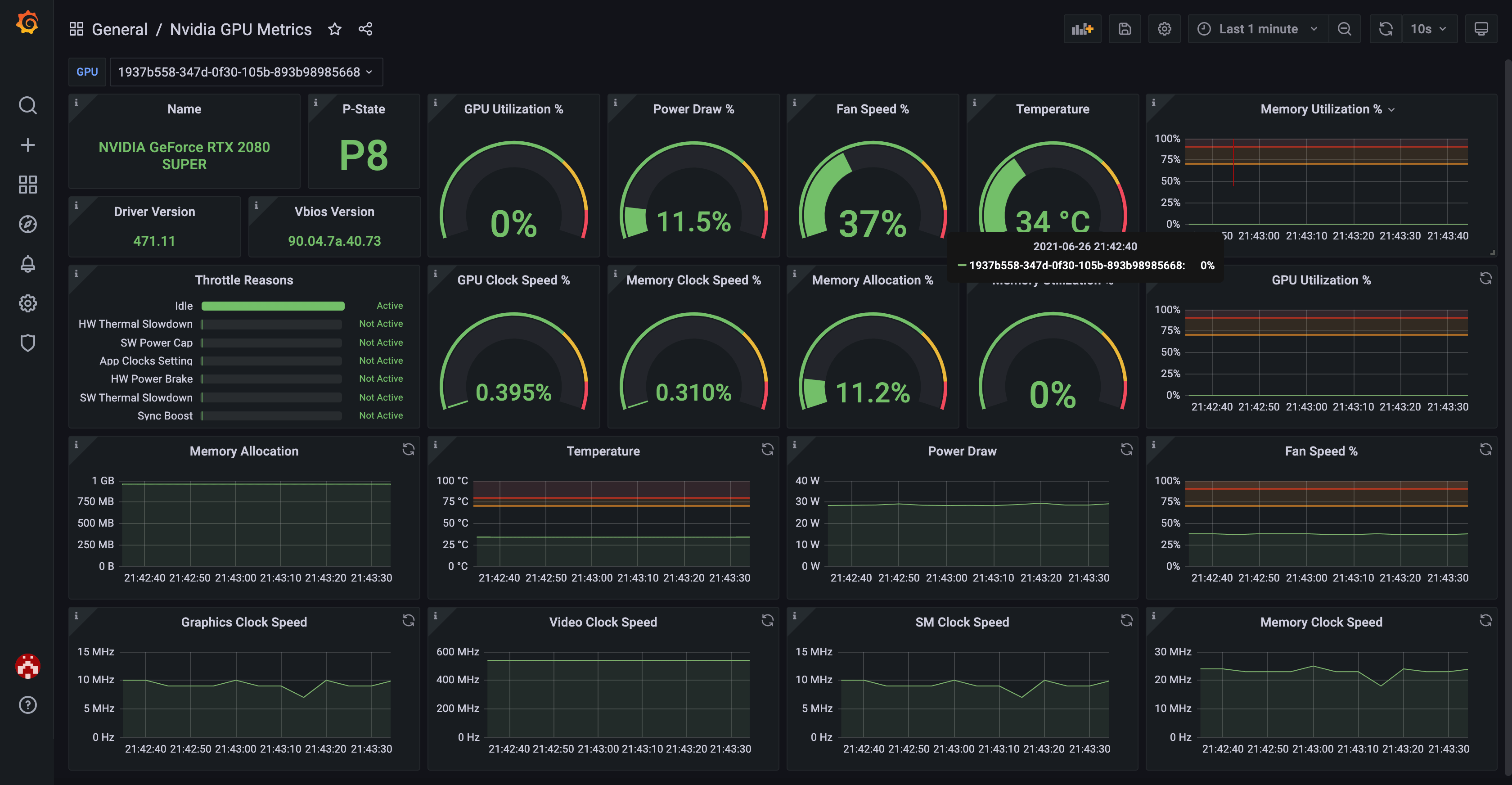
You can use the official Grafana dashboard to see your GPU metrics in a nicely visualized way.
Here's how it looks like:
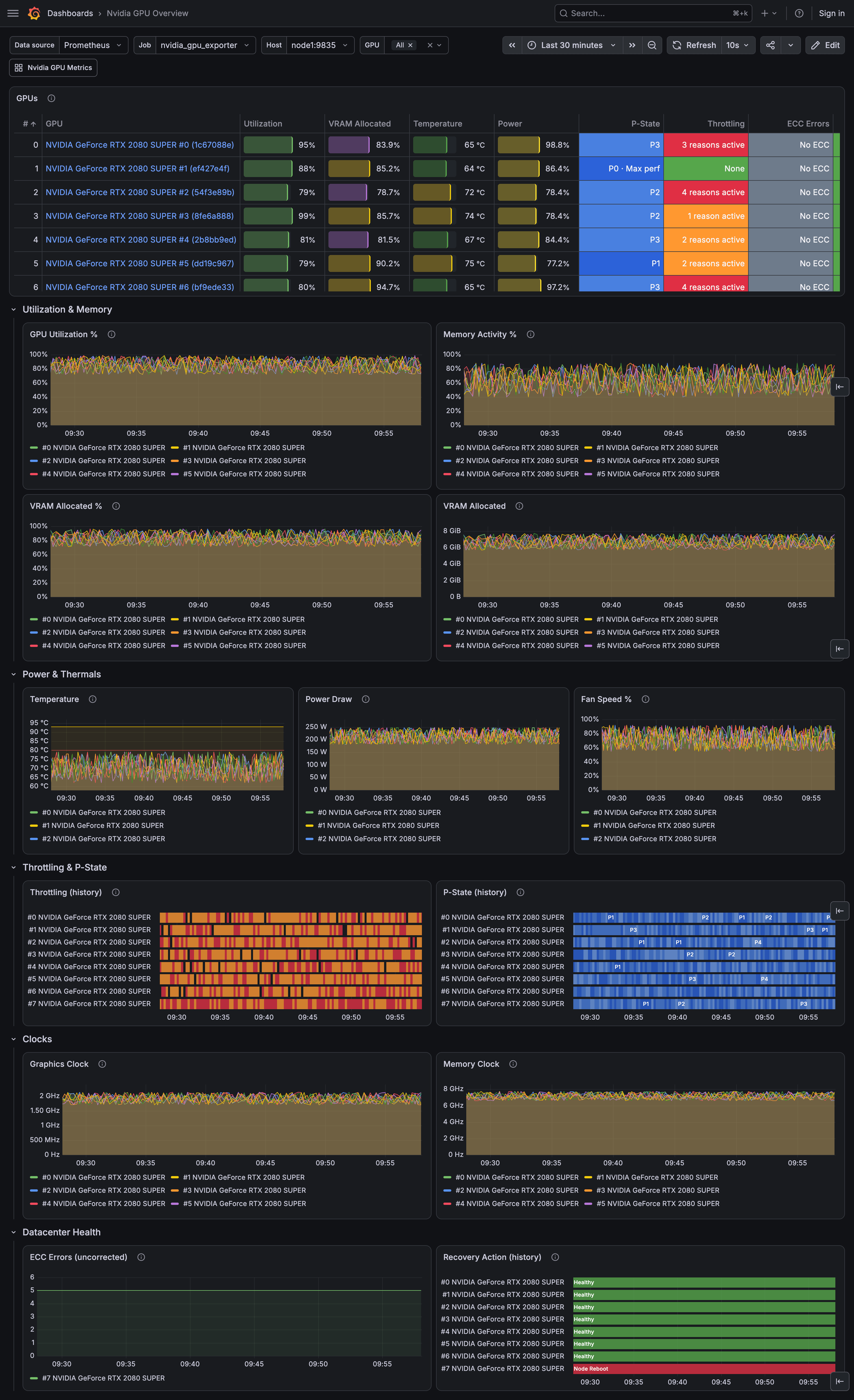
For machines with more than one GPU there is a companion
overview dashboard
that compares all GPUs of a node side by side and drills down into the
single-GPU dashboard above. Import it from the JSON file, or enable
grafanaDashboard in the Helm chart to get both dashboards provisioned.
See INSTALL.md for details.
Release artifacts are signed so you can check they came from this project's release pipeline:
- The
checksums.txtfile attached to each release is signed with GPG (checksums.txt.asc), which covers every binary, archive and package. - The container images and the Helm chart are signed keyless with cosign, tied to the release workflow's identity.
See INSTALL.md for the exact verification commands, and the chart README for the chart.
See CONFIGURE.md for details.
See METRICS.md for details.
See CONTRIBUTING.md for details.
The exporter parses nvidia-smi output, which differs across GPU models, driver
versions and operating systems. If you have hardware that isn't covered yet
(datacenter cards, MIG, multi-GPU, Windows/WSL2, brand-new drivers...), you can
help a lot by capturing your nvidia-smi output with one command:
./internal/captures/collect.sh # add --load for an under-load sample tooIt needs only nvidia-smi, bash, and the standard core utilities (awk,
sed, ...), runs read-only, and masks identifiers (GPU UUID, serial, hostname)
by default. It writes one .txt file: commit it and open a PR, or attach it to
an issue. See internal/captures/README.md.